
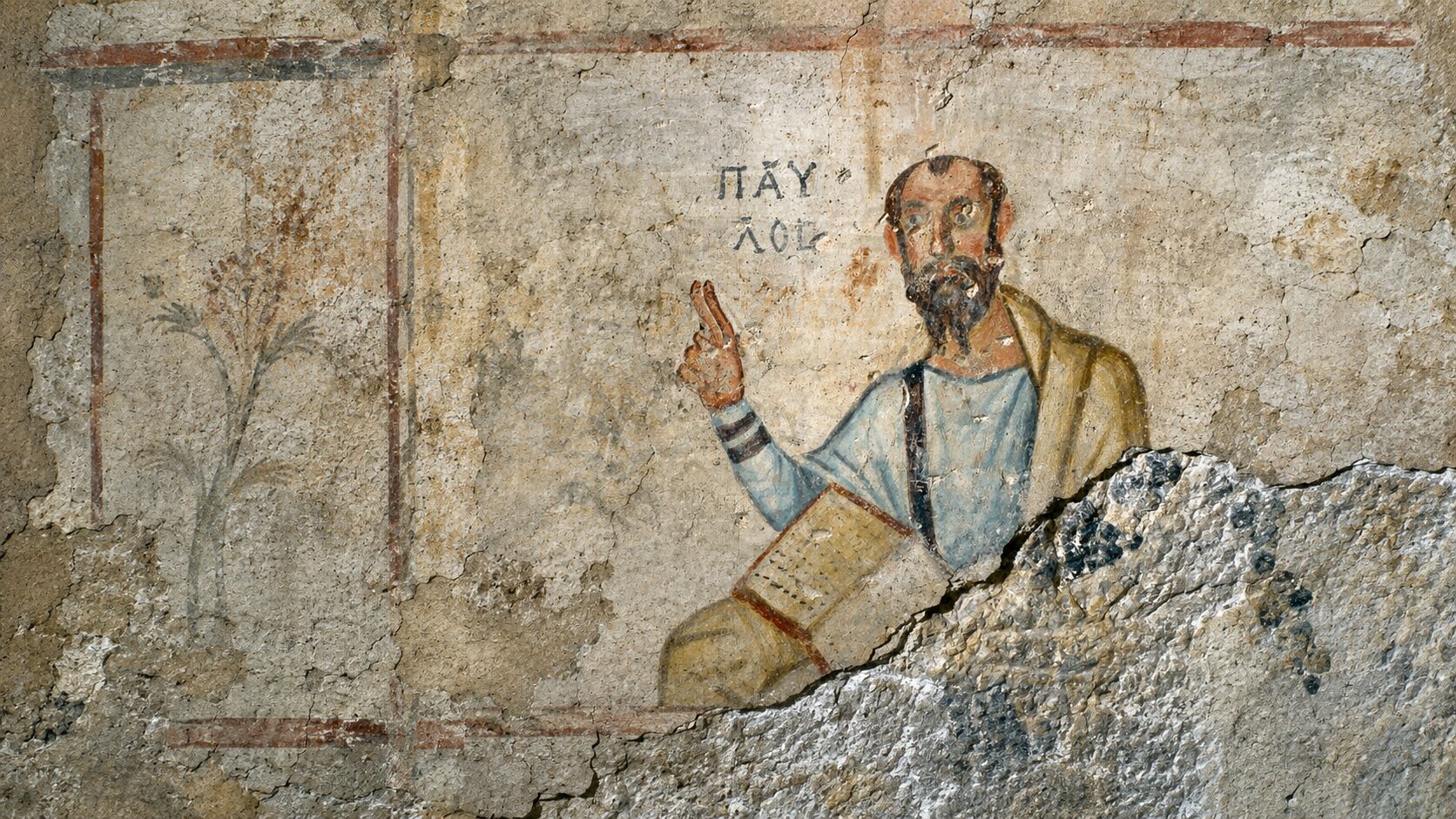
The apostle Paul is one of the most familiar figures in Christian history, and that familiarity is part of the problem. Many readers already “know” Paul before they read him. He is often imagined as the former Jew (Saul) who left Judaism behind, the preacher of grace who rejected law, the founder of Christianity, or the theologian who taught that Jewish covenant identity no longer mattered after Christ. But if we look closely, the Paul of the New Testament is stranger, more historically particular, and more deeply Jewish than these inherited portraits allow.
Paul describes himself as “circumcised the eighth day, of the nation of Israel, of the tribe of Benjamin, a Hebrew of Hebrews” (Phil 3:5 NASB). In Romans he asks, “God has not rejected His people, has He?” and answers, “Far from it! For I too am an Israelite, a descendant of Abraham, of the tribe of Benjamin” (Rom 11:1 NASB). Before Roman authorities, he insists, “I have committed no offense either against the Law of the Jews or against the temple or against Caesar” (Acts 25:8 NASB).
These statements create a tension for many modern readers. How can Paul claim to be an Israelite, a Benjaminite, and a Jew who had committed no offense against the Law (ex. Rom 11:1, Rom 9:3-5, 2 Cor 11:22, Gal, 2:7-9, 1 Cor 7:18-20, Acts 21:24,Acts 25:8), while also insisting that a person is not justified by “works of the Law” but through faith in Jesus Messiah? Was Paul rejecting Torah, or are we misunderstanding the question he was answering?
Due to this topic having such significant development and research over the past 50+ years, this article will present recent scholarly arguments to explore the life of Paul, the most commonly misunderstood apostle in the first century (2 Peter 3:15-16) and today. The article will be lengthy when compared to my other articles, and include numerous footnotes to point to scholarly resources that support these arguments and encourage further study.
The thesis of this article is that Paul is best understood as a first-century Jewish apostle of Israel’s Messiah to the nations. His central question was not, “How can people escape Judaism?” but, “How can Gentiles—idol-worshiping non-Jews from the nations—share in the promises made to Abraham without becoming Jews through circumcision?” This can be described as the “Gentile problem,” and it provides one of the clearest ways to make sense of Paul’s letters without turning Paul against the Judaism he clearly identifies with.
1. Four Major Ways of Reading Paul
Modern Pauline scholarship has produced several major interpretive models. The first is often called the Lutheran or anti-legalistic reading. In this view, Paul’s argument against “works of the Law” is understood as a critique of human attempts to earn salvation. Judaism, on this reading, becomes the foil: a religion of law, merit, and human achievement, while Paul proclaims grace, faith, and divine gift.1 This approach rightly emphasizes that Paul denies human boasting before God (Rom 3:27–28; Gal 2:16; Eph 2:8–9), but it has often depended on a historically distorted picture of ancient Judaism. 2
A major challenge to this model argued that Second Temple Judaism was not a religion of works-righteousness. Jewish covenant life can be described as a pattern in which God graciously elects Israel, gives the covenant, and Israel responds by faithful obedience within that covenant.3 Judaism has too often been constructed by Christians as a religion of law without grace, but this is a serious distortion, both historically and theologically.4
The second model, the New Perspective on Paul, accepts this correction but reframes Paul’s concern. Paul was not opposing legalism but Jewish ethnic boundary markers such as circumcision, food laws, and Sabbath. In this view, “works of the Law” refers not to generic moral effort but to practices that marked Jews off from Gentiles.5 The strength of this approach is that it relocates Paul in the concrete Jew-Gentile tensions of the first century. Its weakness is that it can still portray Judaism negatively, not as legalistic but as ethnocentric—as though Paul’s problem were Jewish concern for Jewish distinctiveness. This model is most often associated with James D. G. Dunn and N. T. Wright.
The third model is the apocalyptic or post-New Perspective reading. This view stresses Paul’s conviction that God has acted dramatically in Messiah to defeat Sin, Death, and the present evil age (Gal 1:4; Rom 5–8).6 Paul’s gospel is not merely about how individuals are justified; it is about God’s cosmic rescue through the death and resurrection of Messiah. This model rightly highlights the new creation dimensions of Paul’s thought (2 Cor 5:17; Gal 6:15), though some versions risk making Messiah’s arrival so discontinuous with Israel’s story that Judaism becomes part of the old world left behind.7
The fourth model, often called Paul within Judaism, argues that Paul remained a Torah-shaped Jew whose mission was directed primarily to Gentiles. This approach does not require every scholar in the discussion to agree on every detail, but it shares a basic methodological instinct: Paul should not be interpreted as standing outside Judaism and critiquing it as a failed religion. He should be read as a Jewish thinker working within the diverse Judaisms of the Second Temple world.8 From this perspective, Paul’s arguments must be conceptualized in relation to Jews and non-Jews, since Paul is usually explaining how non-Jews are to relate rightly to Israel’s God.9
Before moving further, one clarification is essential. Paul was not arguing against a single, formal “Judaism” as though all Jews in the first century believed and practiced the same things. It is more historically accurate to speak of diverse Jewish communities and interpretations within the wider Jewish world, Some scholars refer to this as “Judaisms of the first century”.10 First-century Jews disagreed about priesthood, purity, resurrection, Gentile inclusion, Rome, Temple leadership, calendars, halakhah, and messianic expectation. Pharisees, Sadducees, Essenes, apocalyptic visionaries, diaspora synagogue communities, priestly elites, and Jesus-following Jews did not all think alike.11 This matters because Paul should not be treated as if he discovered what was wrong with “Judaism” as such. He argued as a Jew, from Israel’s Scriptures, that the God of Abraham had acted in Jesus the Messiah to bring the promised blessing to the nations – The Gentiles (Gen 12:3; Isa 49:6; Rom 15:8–12; Gal 3:8).
This was not a new idea to Paul, but understood his Gentile mission as the fulfillment of God’s promises that Abraham’s blessing would reach “all the families of the earth” (Gen 12:3), that the nations would stream to Zion to learn God’s ways (Isa 2:2–4), that Israel would be “a light of the nations” (Isa 49:6), that foreigners would join themselves to the Lord (Isa 56:6–8), and that many peoples would seek the God of Israel (Zech 8:20–23).
2. The Key to Understanding Paul: The Gentile Problem
A major misunderstanding in many readings of Paul is the assumption that first-century Judaism taught salvation by human effort. In that reading, the phrase “works of the Law” is taken to mean “good works” in general, as though Paul were arguing against people trying to earn salvation by moral achievement.12 But that does not accurately describe what ancient Judaism taught.13 Israel’s Scriptures and early Jewish sources assume that God chose Israel by grace, made covenant with His people, provided atonement for sin, and called Israel to faithful obedience within that covenant. The more pressing question in Paul’s Gentile mission was not whether someone could earn salvation by doing enough good works, but whether Gentiles had to become Jews in order to share in the salvation promised to Israel.
This argument depends largely on how we understand Paul’s phrase “works of the Law.” Modern readers often hear that phrase as a reference to moral effort or generic good deeds. But in Paul’s first-century context, it more likely refers to practices that marked out Jewish covenant identity—especially circumcision, food laws, purity concerns, and other boundary-defining works of Torah, or torah observance as covenantal identity practice.14 This reading is strengthened by historical evidence from the Dead Sea Scrolls, especially 4QMMT, where a similar phrase refers to specific rulings concerning Torah observance and communal identity.15 In other words, Paul is not primarily arguing against the idea that people can earn salvation by works. He is arguing against the claim that Gentiles must take on Jewish covenant identity in order to be included among the people redeemed by Israel’s Messiah.16
This fits directly with Paul’s calling from God. Paul says he received “grace and apostleship to bring about the obedience of faith among all the Gentiles” (Rom 1:5 NASB), calls himself “an apostle of Gentiles” (Rom 11:13 NASB), and distinguishes his mission “to the uncircumcised” from Peter’s mission “to the circumcised” (Gal 2:7 NASB). That Gentile focus explains why circumcision becomes such a flashpoint. Circumcision was not a random ritual; in Genesis 17, it was the sign of God’s covenant with Abraham and his physical descendants. The question in Paul’s assemblies was therefore not whether circumcision mattered, but whether Gentile men had to become circumcised and take on Jewish covenant identity in order to inherit Abraham’s promises.17
Paul’s answer was no—not because circumcision was bad, obsolete, or meaningless, but because Gentiles do not become Abraham’s seed by altering their flesh and becoming Jewish. When Paul warns, “if you receive circumcision, Christ will be of no benefit to you” (Gal 5:2 NASB), he is not declaring Jewish circumcision worthless. He is warning Gentiles not to seek Jewish identity as the basis of their inclusion in Messiah. Gentiles are included through Israel’s Messiah and the gift of the Spirit, not by becoming Jews.18
3. Abraham, the Spirit, and Gentile Inclusion
If Gentiles do not inherit Abraham’s promises by becoming Jews through “works of the Law,” then how are they included? Paul’s answer is that Gentiles inherit through Messiah, Abraham’s promised “seed,” and through the Spirit given to those who belong to Him. In Galatians 3, Paul argues that the promise was spoken to Abraham and to his “seed,” whom he identifies as Messiah (Gal 3:16). Therefore, Gentiles do not become Abraham’s heirs independently, nor by taking on Jewish covenant identity, but by belonging to Messiah: “And if you belong to Christ, then you are Abraham’s descendants, heirs according to promise” (Gal 3:29 NASB).
This is why the Spirit is so central to Paul’s argument. He asks the Galatians, “Did you receive the Spirit by works of the Law, or by hearing with faith?” (Gal 3:2 NASB). He then explains that Messiah redeemed His people “in order that in Christ Jesus the blessing of Abraham would come to the Gentiles, so that we would receive the promise of the Spirit through faith” (Gal 3:14 NASB). The Spirit is not merely a private religious experience; He is the end-time evidence that Gentiles are being joined to Abraham’s blessing through Israel’s Messiah.19
Romans 11 describes this inclusion with the image of grafting. Gentiles are wild olive branches grafted into Israel’s cultivated olive tree, made to share in “the rich root of the olive tree” (Rom 11:17 NASB). But grafting does not mean replacement. Paul immediately warns Gentiles, “do not be arrogant toward the branches” (Rom 11:18 NASB). Gentiles are brought into Israel’s story by mercy; they do not become the root, nor do they displace the natural branches.
This is why Paul can insist on both unity and distinction. In Messiah, Jews and Gentiles share one Lord, one Spirit, one hope, and one God (Rom 3:29–30; 1 Cor 12:13; Eph 2:11–22). Yet this unity does not require Gentiles to become Jews or Jews to become Gentiles. Paul can say that “there is neither Jew nor Greek” in relation to shared inheritance in Messiah (Gal 3:28), while still distinguishing his mission to the uncircumcised from Peter’s mission to the circumcised (Gal 2:7–9), instructing the circumcised not to erase their circumcision and the uncircumcised not to seek it (1 Cor 7:18–20), and warning Gentiles not to boast over Israel’s natural branches (Rom 11:17–24). Paul’s vision is not “one new Gentile,” where Jewish identity disappears, nor “one new Jew,” where Gentiles must take on Jewish identity. It is one reconciled body in Messiah, where Jews and Gentiles worship Israel’s God together without either people being erased.20
Conclusion: Recovering Paul for the Church
This brings us back to the central thesis: Paul is best understood as a first-century Jewish apostle of Israel’s Messiah to the nations. Paul certainly denies that anyone can boast before God or establish covenant status by human achievement (works salvation). But in his letters to Gentile assemblies, that concern is bound up with a more specific first-century question: must Gentiles become Jews through circumcision and Torah observance in order to share in Abraham’s promises? His central concern was the Gentile problem: How can Gentiles—non-Jews from the nations—inherit the promises made to Abraham without becoming Jews through circumcision and “works of the Law”? Paul’s answer was not that Jewish identity no longer mattered, but that Gentiles are included through Israel’s Messiah, Abraham’s promised seed, and through the Spirit poured out upon those who belong to Him (Gal 3:14, 16, 29).
When we read Paul in his context, it helps us see the full message of his teaching much more clearly. It does not remove the truth that we cannot earn our salvation, but it connects that truth to Paul’s broader message of Gentile inclusion without becoming Jewish, and unity in the assembly of believers without erasing distinctions. It also helps prevent theological inaccuracies that are often drawn from Paul’s letters and allows us to appreciate more deeply the mystery God has revealed in His inclusion of the Gentiles. Paul describes this mystery in Ephesians 3:6: “that the Gentiles are fellow heirs and fellow members of the body, and fellow partakers of the promise in Christ Jesus through the gospel” (NASB).
When we realize the depth of this mystery, our response should be the same as Paul’s when he considered the wisdom and faithfulness of God in light of the inclusion of the gentiles:
“Oh, the depth of the riches, both of the wisdom and knowledge of God! How unsearchable are His judgments and unfathomable His ways! For who has known the mind of the Lord, or who became His counselor? Or who has first given to Him, that it would be paid back to him? For from Him, and through Him, and to Him are all things. To Him be the glory forever. Amen” (Rom 11:33–36 NASB).
Footnotes
- Stephen Westerholm, Perspectives Old and New on Paul: The “Lutheran” Paul and His Critics (Grand Rapids: Eerdmans, 2004). ↩︎
- This is arguably the most popular interpretive model in the protestant tradition. ↩︎
- E. P. Sanders, Paul and Palestinian Judaism: A Comparison of Patterns of Religion (Philadelphia: Fortress, 1977). ↩︎
- This correction is especially associated with Krister Stendahl and E. P. Sanders. ↩︎
- James D. G. Dunn, “The New Perspective on Paul,” Bulletin of the John Rylands Library 65 (1983): 95–122. ↩︎
- Douglas A. Campbell, “Christ and the Church in Paul: A ‘Post-New Perspective’ Account,” in Four Views on the Apostle Paul, ed. Michael F. Bird (Grand Rapids: Zondervan, 2012). ↩︎
- Important representatives include J. Louis Martyn and Douglas Campbell. ↩︎
- Mark D. Nanos, “A Jewish View,” in Four Views on the Apostle Paul, ed. Michael F. Bird (Grand Rapids: Zondervan, 2012). ↩︎
- Major voices in this discussion include Mark Nanos, Magnus Zetterholm, Paula Fredriksen, Pamela Eisenbaum, Anders Runesson, Caroline Johnson Hodge, Matthew Thiessen, Paul Sloan, and others. ↩︎
- Jacob Neusner, Judaism: The Evidence of the Mishnah (Chicago: University of Chicago Press, 1981). ↩︎
- Matthew Thiessen, A Jewish Paul: The Messiah’s Herald to the Gentiles (Grand Rapids: Baker Academic, 2023), chap. 3. ↩︎
- James D. G. Dunn, “Works of the Law and the Curse of the Law (Galatians 3.10–14),” New Testament Studies 31 (1985). ↩︎
- Sanders, Paul and Palestinian Judaism. ↩︎
- James D. G. Dunn, “Works of the Law and the Curse of the Law (Galatians 3.10–14),” New Testament Studies 31 (1985): 523–42. ↩︎
- 4QMMT C 26–31. ↩︎
- Martin G. Abegg Jr., “Paul, ‘Works of the Law’ and MMT,” Biblical Archaeology Review 20.6 (1994). ↩︎
- Mark D. Nanos, “The Question of Conceptualization: Qualifying Paul’s Position on Circumcision in Dialogue with Josephus’s Advisors to King Izates,” in Paul within Judaism: Restoring the First-Century Context to the Apostle, ed. Mark D. Nanos and Magnus Zetterholm (Minneapolis: Fortress, 2015). ↩︎
- Thiessen, A Jewish Paul, chaps. 7–8. ↩︎
- Caroline Johnson Hodge, “The Question of Identity: Gentiles as Gentiles—but also Not—in Pauline Communities,” in Paul within Judaism: Restoring the First-Century Context to the Apostle, ed. Mark D. Nanos and Magnus Zetterholm (Minneapolis: Fortress, 2015). ↩︎
- David Rudolph, “One New Man, Hebrew Roots, Replacement Theology,” rev. July 29, 2024. ↩︎
Leave a Reply
You must be logged in to post a comment.