
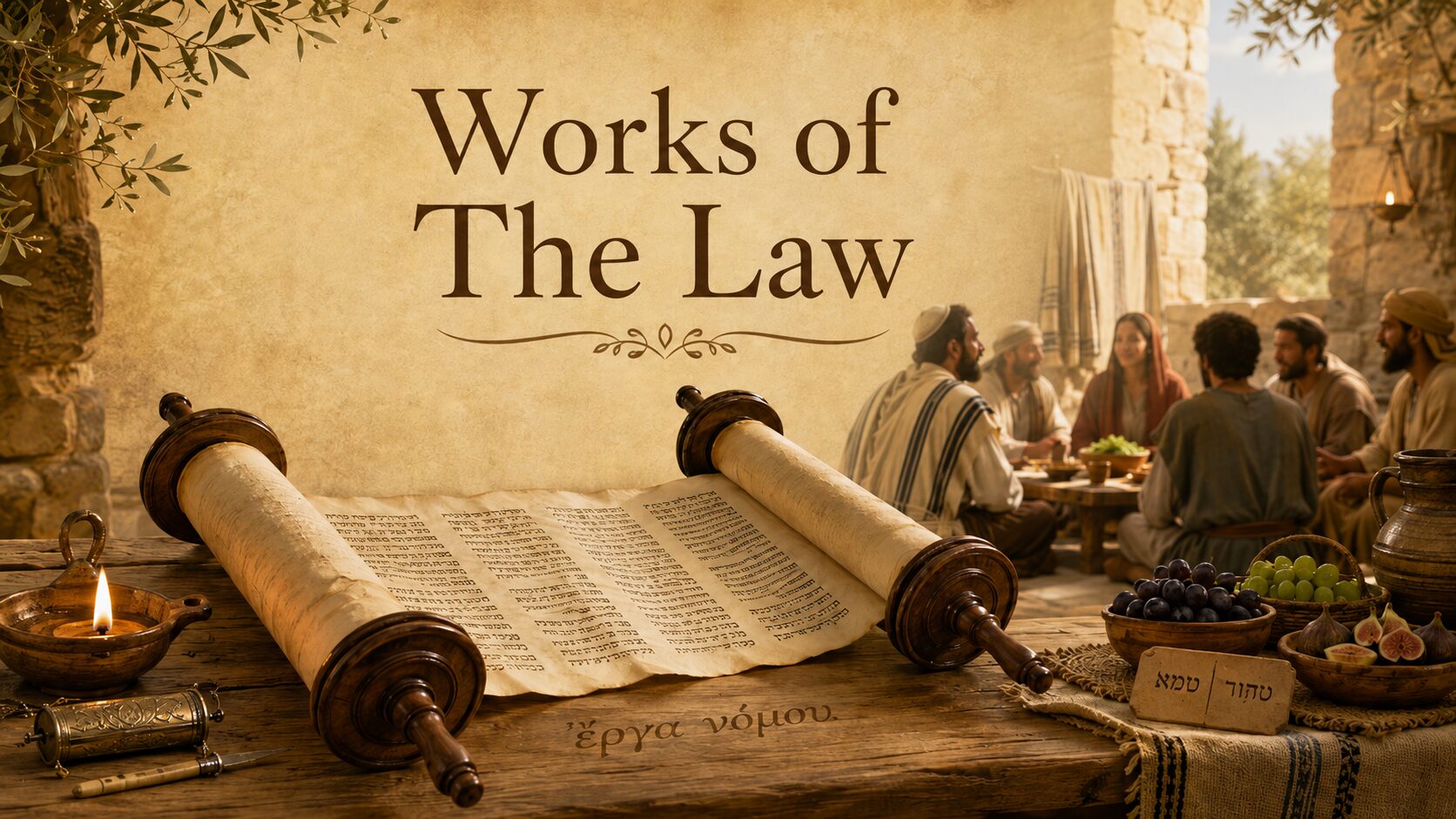
For many readers, Paul’s phrase “works of the law” sounds like a general warning against trying to earn salvation by works. That concern is certainly biblical: no sinner can stand righteous before God by moral achievement (Rom 3:23–24; Eph 2:8–9; Titus 3:5). Yet when we read Paul in his first-century Jewish context, the phrase “works of the law” appears to be more specific than “good works” in general. Paul is addressing the question: Must Gentiles become Jews—marked out by circumcision and Torah-defined boundary practices—in order to belong fully to the people of God in Messiah?
In Paul’s Argument
Paul uses “works of the law” most prominently in Galatians and Romans. In Galatians 2:16 he writes, “nevertheless knowing that a man is not justified by the works of the Law but through faith in Christ Jesus” (NASB). The setting matters. Just before this, Paul confronts Peter in Antioch because Peter had withdrawn from table fellowship with Gentile believers (Gal 2:11–14). The issue was not whether Christians should obey God morally. The issue was whether Gentiles were truly clean and fully accepted in Messiah without taking on Jewish identity through circumcision and related communal practices.
That is why Paul asks Peter, “how is it that you compel the Gentiles to live like Jews?” (Gal 2:14, NASB). The phrase “live like Jews” is crucial. Paul is not rebuking Peter for encouraging holiness, love, justice, or obedience to God. He is rebuking him for acting as though Gentiles must adopt Jewish communal identity in order to share the table as equals. Paul’s gospel insisted that Gentiles are included in Abraham’s blessing through Messiah and the Spirit, not through becoming Jews (Gal 3:7–14, 26–29; Rom 4:9–17; Acts 15:7–11).
4QMMT and “Works of the Law”
This phrase was very difficult for church leaders and scholars to interpret for centuries, which resulted in the phrase being attributed to works based righteousness because we did not have this phrase appear in any other ancient writings, until we discovered the The Dead Sea Scrolls.
The Dead Sea Scrolls help us hear Paul’s phrase with first-century Jewish ears. One important text, commonly called 4QMMT, is titled from the Hebrew phrase miqṣat maʿaśe ha-torah, often translated “some of the works of the law.” This document lists disputed rulings about purity, calendar, and Temple practice. James VanderKam summarizes 4QMMT as a legal text that begins with calendar concerns, lists twenty-two laws over which the writers disagreed with their opponents, and ends with an exhortation to accept these teachings.1
This does not prove that Paul and 4QMMT use the phrase in exactly the same way. Paul is not quoting Qumran. But 4QMMT does show that “works of the law” could refer to particular Torah rulings that marked out a community’s covenant faithfulness and identity. In other words, the phrase belonged to Jewish legal and communal debates. It was not simply a timeless phrase for “trying hard to be good.”2
Identity Markers, Not Merit Badges
James D. G. Dunn famously argued that “works of the law” in Paul refers especially to those practices that functioned as Jewish boundary markers—circumcision, food laws, and Sabbath.3 N. T. Wright similarly describes them as “badges” of covenant membership.4 These practices were not bad. They were biblical signs of Israel’s calling (Gen 17:9–14; Exod 31:13–17; Lev 11; Deut 14). The problem came when such signs were treated as requirements for Gentiles to be recognized as full members of God’s people in Messiah.
This reading makes sense of Galatians. Circumcision dominates the letter (Gal 2:3–5; 5:2–6; 6:12–15). Table fellowship stands behind Paul’s confrontation with Peter (Gal 2:11–14). The question of Gentile inclusion runs through the argument from Abraham (Gal 3:8: “All the nations will be blessed in you,” NASB). Paul’s concern is not that Jews are too Jewish, nor that Torah is evil. His concern is that Gentiles must not be forced to become Jews in order to receive what God has given through Israel’s Messiah.
Mark Nanos sharpens this point by arguing that Paul’s concern is particularly with identity transformation—Gentiles being pressured to become Jews through circumcision—rather than with Jewish Torah observance as such. In his words, Paul’s contrast between erga nomou (works of the law) and faithfulness concerns whether non-Jews who have turned to God through Messiah must “also become Jews.”5 Paul T. Sloan likewise argues that in Galatians 2, Paul’s target is not Jewish law-observance in itself but making the Law the basis of justification and Gentile inclusion.6
Does This Undermine Justification by Faith?
Not at all. It clarifies it. Paul’s doctrine of justification is still gloriously centered on God’s grace in Messiah. “By the works of the Law no flesh will be justified in His sight” (Rom 3:20, NASB). Jews and Gentiles alike need the redemption that is in Messiah Jesus (Rom 3:21–26). No one is declared righteous by ethnic status, ritual boundary markers, or moral achievement.
But Paul’s argument is also communal. Justification by faith means Gentiles are welcomed as Gentiles, not as second-class outsiders awaiting conversion to Jewish identity. God is “God of Jews only” and also “God of Gentiles also” (Rom 3:29, NASB). In Messiah, Gentiles are grafted into Israel’s rich root (Rom 11:17–18), brought near to the commonwealth of Israel (Eph 2:11–19), and made heirs of Abraham’s promise (Gal 3:29)—without replacing Israel and without erasing Jewish identity.
Why This Matters for Discipleship
Reading Paul this way helps us avoid two mistakes. First, we should not turn Paul into an enemy of Judaism or Torah. Paul remained a Jewish apostle proclaiming Israel’s Messiah to the nations (Rom 11:1; Acts 21:20–26; 1 Cor 9:20). Second, we should not require Gentile believers to become Jewish in order to be fully faithful disciples of Jesus. The gospel creates one family in Messiah without flattening the distinction between Jew and Gentile (Gal 3:28; Eph 2:14–16).
For believers, this deepens rather than weakens the message of grace. We are justified by faith in Messiah, not by our résumé, our ethnicity, our rituals, or our religious performance. And that grace teaches us to welcome whom God has welcomed. The table of Messiah is not guarded by human boundary markers but opened by the crucified and risen Son of God, who gave himself “so that in Christ Jesus the blessing of Abraham might come to the Gentiles” (Gal 3:14, NASB).
Footnotes
- James C. VanderKam, An Introduction to Early Judaism, 2nd ed. (Grand Rapids: Eerdmans, 2022), chap. 6, section on “4QMMT.” ↩︎
- Elisha Qimron and John Strugnell, Qumran Cave 4. V: Miqṣat Maʿaśe Ha-Torah (DJD 10; Oxford: Clarendon, 1994). See also Martin G. Abegg Jr., “Paul, ‘Works of the Law’ and MMT,” Biblical Archaeology Review 20, no. 6 (1994): 52–55. ↩︎
- James D. G. Dunn, “The New Perspective on Paul,” Bulletin of the John Rylands Library 65 (1983): 95–122; idem, The New Perspective on Paul: Collected Essays (rev. ed.; Grand Rapids: Eerdmans, 2008). ↩︎
- N. T. Wright, The New Testament and the People of God (Minneapolis: Fortress, 1992), 237; idem, Justification: God’s Plan and Paul’s Vision (Downers Grove, IL: IVP Academic, 2009). ↩︎
- Mark D. Nanos, “The Question of Conceptualization: Qualifying Paul’s Position on Circumcision in Dialogue with Josephus’s Advisors to King Izates,” in Paul within Judaism: Restoring the First-Century Context to the Apostle, ed. Mark D. Nanos and Magnus Zetterholm (Minneapolis: Fortress, 2015). ↩︎
- Paul T. Sloan, “Jewish Law-Observance in Paul,” Religions 15 (2024). ↩︎
Leave a Reply
You must be logged in to post a comment.