
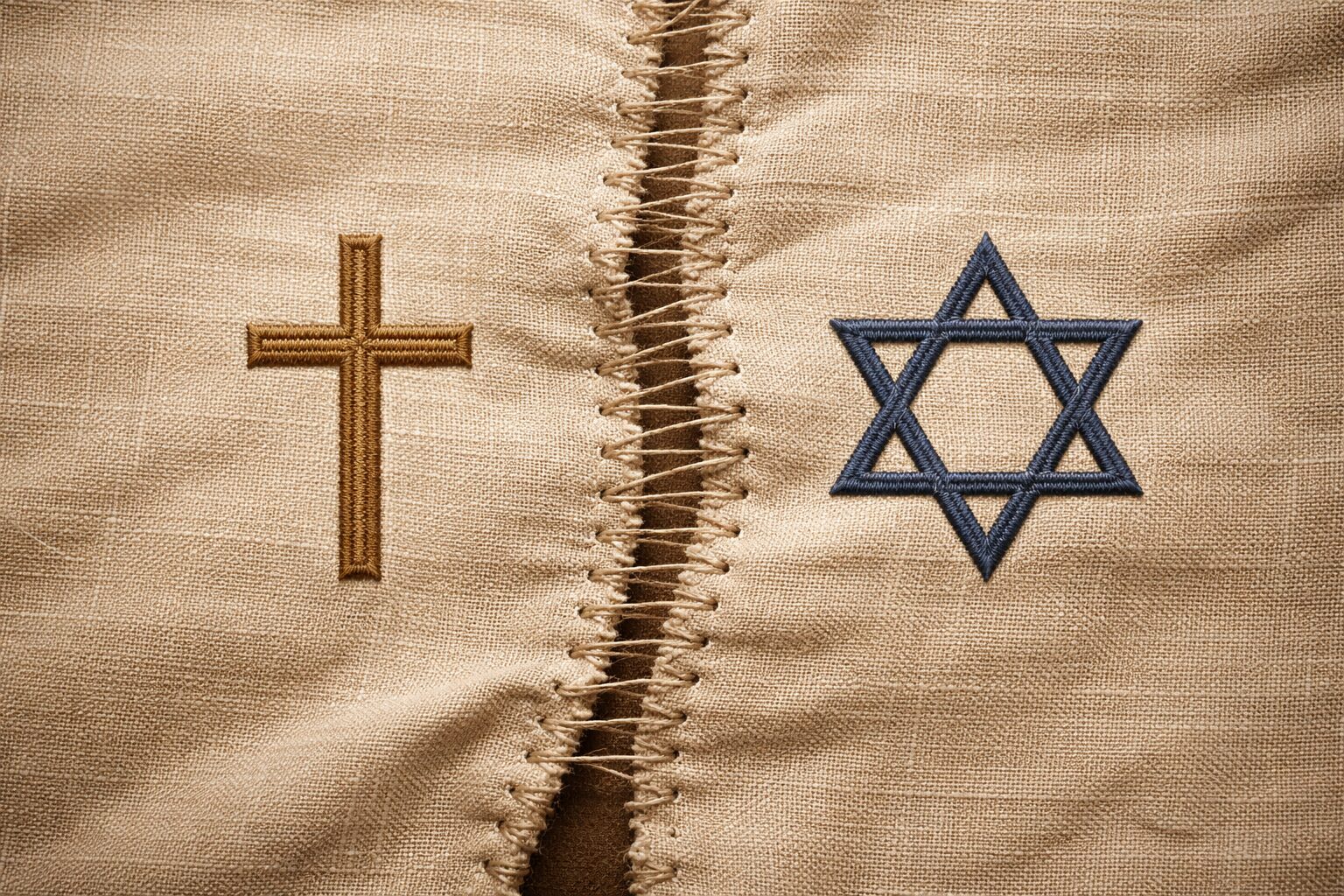
The Twentieth Century and the Reopening of a Closed Door¹
For nearly seventeen centuries, Jewish faith in Yeshua existed under severe constraint. The structures established in late antiquity made it virtually impossible for a Jew to confess Yeshua without abandoning Jewish identity, community, and practice (Parting of The Ways). Against that long history, the twentieth century stands apart as a moment when those structures began to crack. A convergence of catastrophe, repentance, scholarship, and renewed Jewish expression reopened an ancient possibility: Jewish allegiance to Yeshua without the erasure of Jewish life.²
The Holocaust and the Collapse of Christian Certainty³
The Holocaust forced a reckoning that Christian theology could no longer avoid. While the Nazi project was not a Christian movement, it unfolded within cultures long shaped by Christian teachings that portrayed Jews as rejected by God, cursed, or spiritually obsolete. Centuries of theological contempt had helped normalize Jewish marginalization, making their destruction imaginable to many who stood by in silence.⁴
In the aftermath of the Shoah, the moral credibility of any theology that implied divine rejection of the Jewish people collapsed. Christian thinkers were compelled to ask whether doctrines about Israel’s supposed displacement had contributed to a climate where Jewish suffering was rationalized. For the first time on a wide scale, the idea that God had finished with Israel was no longer merely debated—it was ethically indicted.⁵
This crisis created the necessary conditions for Jewish believers in Yeshua to insist that faith in Messiah need not align them with a tradition that had persecuted their own people.⁶
Vatican II and Institutional Repentance⁷
The theological shockwaves of the Holocaust found formal expression in the Second Vatican Council, particularly in Nostra Aetate (1965). Here, the Roman Catholic Church explicitly rejected the charge of collective Jewish guilt for the death of Yeshua and affirmed that the Jewish people remain beloved by God.⁸
While Vatican II did not resolve every theological tension, it marked a historic rupture with centuries of ecclesial anti-Judaism. Just as importantly, it demonstrated that long-standing Christian teachings about Jews were not untouchable. For Messianic Judaism, this was a watershed moment. It signaled that Jewish faith in Yeshua might no longer require total dissociation from Jewish identity in the eyes of the broader Christian world.⁹
Archaeology and the Recovery of the Jewish World of Yeshua¹⁰
At the same time, twentieth-century archaeology profoundly reshaped understanding of the New Testament world. The Dead Sea Scrolls revealed a richly textured Jewish landscape filled with messianic expectation, scriptural interpretation, and theological diversity. Concepts once labeled “Christian” were shown to be thoroughly Jewish and pre-Christian in origin.¹¹
Other discoveries reinforced the historical reality of Israel and its biblical story, grounding Scripture firmly in Jewish history rather than abstract theology. Together, these findings dismantled the idea that the movement centered on Yeshua emerged outside Judaism. Instead, it became clear that the earliest Yeshua-believing communities were fully embedded within Jewish life.¹²
This recovery made it intellectually credible once again to speak of Jewish disciples of Yeshua as historically normative rather than anomalous.¹³
Modern Scholarship and the Reframing of the Separation¹⁴
Modern biblical scholarship further undermined inherited assumptions by challenging the idea that Judaism and Christianity split cleanly in the first century. Increasingly, scholars recognized the separation as a long, uneven process shaped by politics, power, and social pressures, reaching its decisive form only in the fourth century and beyond.¹⁵
This reframing was essential for the reemergence of Messianic Judaism. If Jewish faith in Yeshua was not originally incompatible with Jewish life, then its later exclusion was historical rather than theological. The question shifted from “Why did Jews abandon Yeshua?” to “Why was Jewish faith in Yeshua made impossible?”¹⁶
The Reemergence of Messianic Judaism¹⁷
Out of these converging developments arose the modern Messianic Jewish movement. Jewish men and women began confessing Yeshua as Messiah while remaining publicly and communally Jewish. This was not an innovation, but a recovery of a suppressed identity.¹⁸
For the church, the movement challenged the assumption that Jewish covenantal life must end at the cross. For Gentile believers, it restored the gospel to its original Jewish framework and re-centered discipleship within the story of Israel. For the Jewish world, it reintroduced a reality long erased: belief in Yeshua had never disappeared from Jewish history—it had been forcibly excluded.¹⁹
Conclusion
The twentieth century did not resolve every tension between Judaism and Christianity, but it decisively reopened a door closed since late antiquity. Through tragedy, repentance, discovery, and renewed Jewish witness, the possibility of Jewish faithfulness to Yeshua without the loss of Jewish identity reemerged.
In this light, modern Messianic Judaism stands not as a novelty, but as a testimony—to history remembered more honestly, to theology refined by humility, and to a God whose covenant with Israel was never revoked.²⁰
Bibliography
- Mark S. Kinzer, Postmissionary Messianic Judaism (Grand Rapids: Brazos, 2005), 19–45.
- Daniel Boyarin, Border Lines: The Partition of Judaeo-Christianity (Philadelphia: University of Pennsylvania Press, 2004), 1–9.
- Franklin H. Littell, The Crucifixion of the Jews (New York: Harper & Row, 1975), 9–31.
- Jules Isaac, The Teaching of Contempt (New York: Holt, Rinehart and Winston, 1964), 1–15.
- R. Kendall Soulen, The God of Israel and Christian Theology (Minneapolis: Fortress Press, 1996), 1–18.
- David J. Rudolph, A Jew to the Jews: Jewish Contours of Pauline Flexibility in 1 Corinthians 9:19–23 (Tübingen: Mohr Siebeck, 2011), 3–6.
- John Connelly, From Enemy to Brother: The Revolution in Catholic Teaching on the Jews, 1933–1965 (Cambridge, MA: Harvard University Press, 2012), 1–4.
- Vatican Council II, Nostra Aetate (1965), §4.
- Edward Kessler, An Introduction to Jewish-Christian Relations (Cambridge: Cambridge University Press, 2010), 173–78.
- James C. VanderKam and Peter Flint, The Meaning of the Dead Sea Scrolls (San Francisco: HarperSanFrancisco, 2002), 1–10.
- Eileen M. Schuller, “The Dead Sea Scrolls and Jewish-Christian Dialogue,” in From Judaism to Christianity, ed. Patricia Walters (Leiden: Brill, 2010), 48–58.
- Lawrence H. Schiffman, Reclaiming the Dead Sea Scrolls (Philadelphia: Jewish Publication Society, 1994), 25–38.
- Geza Vermes, Jesus the Jew (Philadelphia: Fortress Press, 1973), 1–13.
- Paula Fredriksen, From Jesus to Christ (New Haven: Yale University Press, 2000), 1–7.
- Judith Lieu, Neither Jew nor Greek? (Edinburgh: T&T Clark, 2002), 1–15.
- Boyarin, Border Lines, 219–29.
- David Rudolph and Joel Willitts, Introduction to Messianic Judaism (Grand Rapids: Zondervan, 2013), 1–18.
- Kinzer, Postmissionary Messianic Judaism, 205–25.
- Soulen, The God of Israel and Christian Theology, 160–75.
- Romans 11:28–29; cf. Soulen, The God of Israel and Christian Theology, 177–82.
Leave a Reply
You must be logged in to post a comment.