

The Parting of the Ways: The fracture of the ekklesia
The separation between the Jewish community and the Yeshua-believing ekklesia (The “Church”) was not an apostolic development but a gradual historical process shaped by Roman law, imperial violence, and post-Temple Jewish survival strategies. In the first century, the movement around Yeshua functioned entirely within Judaism. Jewish believers continued Temple worship, Torah observance, and synagogue participation, while Gentiles joined the movement through Israel’s Messiah rather than apart from Israel’s covenantal framework (Acts 2:46; 21:20–26).
The decisive pressures driving separation were social and political before they were theological.
Roman Law, Taxation, and Political Suspicion
Following the destruction of Jerusalem in 70 CE, Rome reclassified Jewish identity as a potential liability. Emperor Vespasian instituted the fiscus Judaicus, redirecting the Temple tax to the cult of Jupiter Capitolinus.¹ This tax functioned as both economic punishment and legal classification. To be identified as Jewish—or to live “according to Jewish customs”—now entailed financial burden and imperial scrutiny.
Under Domitian, enforcement intensified. Roman sources describe investigations into those accused of vivere more Iudaico, even when they were not ethnically Jewish.² For Gentile believers in Yeshua, continued association with Jewish communities became increasingly dangerous. Disassociation offered protection from taxation and suspicion, incentivizing the emergence of a non-Jewish Christian identity.
Messianic Kingship and Intra-Communal Fracture
Roman persecution of the Yeshua movement was driven primarily by political language, not theology. Proclaiming Yeshua as Messiah and Lord necessarily implied kingship. In a Roman imperial system, the announcement of a rival king constituted sedition. This concern appears already in the Gospels, where Yeshua is accused before Pilate of claiming to be “Christ, a king” (Luke 23:2), and in Acts, where believers are charged with proclaiming “another king, Jesus” in defiance of Caesar (Acts 17:7).
After the Jewish revolts of 66–70 and 132–135 CE, Roman authorities viewed all messianic movements within Judaism as threats to imperial order. Jewish communities were expected to police internal dissent. Any group whose proclamation risked provoking Roman retaliation endangered the wider community.
This context explains Jewish denunciations of Yeshua-believers to Roman authorities. Under Claudius, disturbances “at the instigation of Chrestus”(reference to Christ) led to expulsions of Jews from Rome, reflecting Roman perception of intra-Jewish conflict centered on messianic claims.³ Under Nero, followers of Christ were executed as enemies of the state, blamed for the Great Fire of Rome.⁴ Distinguishing the Yeshua movement from Judaism became a matter of communal survival.
Second-century Christian sources confirm this dynamic. Justin Martyr accuses Jewish leaders of actively informing Roman authorities against Christians, claiming they sent emissaries throughout the empire to denounce the movement as a dangerous heresy.⁵ While polemical, this testimony aligns with Roman administrative expectations and the political necessity of Jewish self-preservation.
Thus, long before theological separation was formalized, Roman suspicion of messianic kingship made Jewish–Christian coexistence socially untenable. Jewish exclusion of Yeshua-believers preceded, and enabled, later Christian rejection of Jewish covenantal life.
Second–Third Century Christian Polemic
By the mid-second century, Christian intellectuals began to theologize an already-existing social divide. Justin Martyr argued that Torah observance had been imposed on Israel as a punitive measure and was no longer valid. Circumcision and Sabbath were described as temporary signs marking Jews for suffering rather than enduring covenantal gifts.⁶
Later in the second century, Irenaeus of Lyons further consolidated this logic. Although opposing Gnostic rejection of the Hebrew Scriptures, he nevertheless argued that the church had inherited Israel’s promises due to Jewish disobedience, casting Israel as displaced from its covenantal role.⁷ Torah was retained as Scripture but emptied of ongoing Jewish vocation.
By the third century, Christian identity was increasingly defined by non-observance of Torah. Avoidance of Jewish calendar, festivals, and dietary laws functioned as markers of orthodoxy. Conversion from Judaism required total renunciation of Jewish practice and community.
The Fourth Century: Finalization at Nicaea
The Council of Nicaea did not initiate the separation but formally ratified it. Convened under imperial authority by Constantine, the council excluded Jewish believers and codified a Gentile Christian identity detached from Israel’s covenantal narrative. The decoupling of Easter from Passover institutionalized a liturgical rupture already present socially and theologically.
Constantine’s own language leaves little ambiguity: Christians were to “have nothing in common with the Jews.”⁸ At this point, the ekklesia had become structurally incapable of accommodating Jewish disciples of Yeshua.
20th Century Rebirth
The parting of the ways was not divinely mandated. It emerged from Roman taxation, persecution, and political suspicion, compounded by Jewish communal survival strategies and later justified through Christian theological polemic. By the fourth century, the separation was complete, transforming a Jewish messianic movement into a non-Jewish imperial religion.
For nearly sixteen centuries after the fourth century, the structures of Christendom made the existence of Jewish believers in Yeshua within the ekklesia effectively impossible, since confession of Jesus required the abandonment of Jewish identity, practice, and community. This reality began to change only in the twentieth century, with the collapse of Christendom, post-Holocaust theological reassessment, and the emergence of the modern Messianic Jewish movement. The reappearance of publicly Jewish disciples of Yeshua is not a historical novelty, but the recovery of a reality long suppressed. Within a biblical frame, it may be understood as an early fruit of the prophetic hope that Israel will yet recognize her Messiah, not through the dissolution of her identity, but through the faithful fulfillment of God’s enduring promises (Rom 11:25–29).
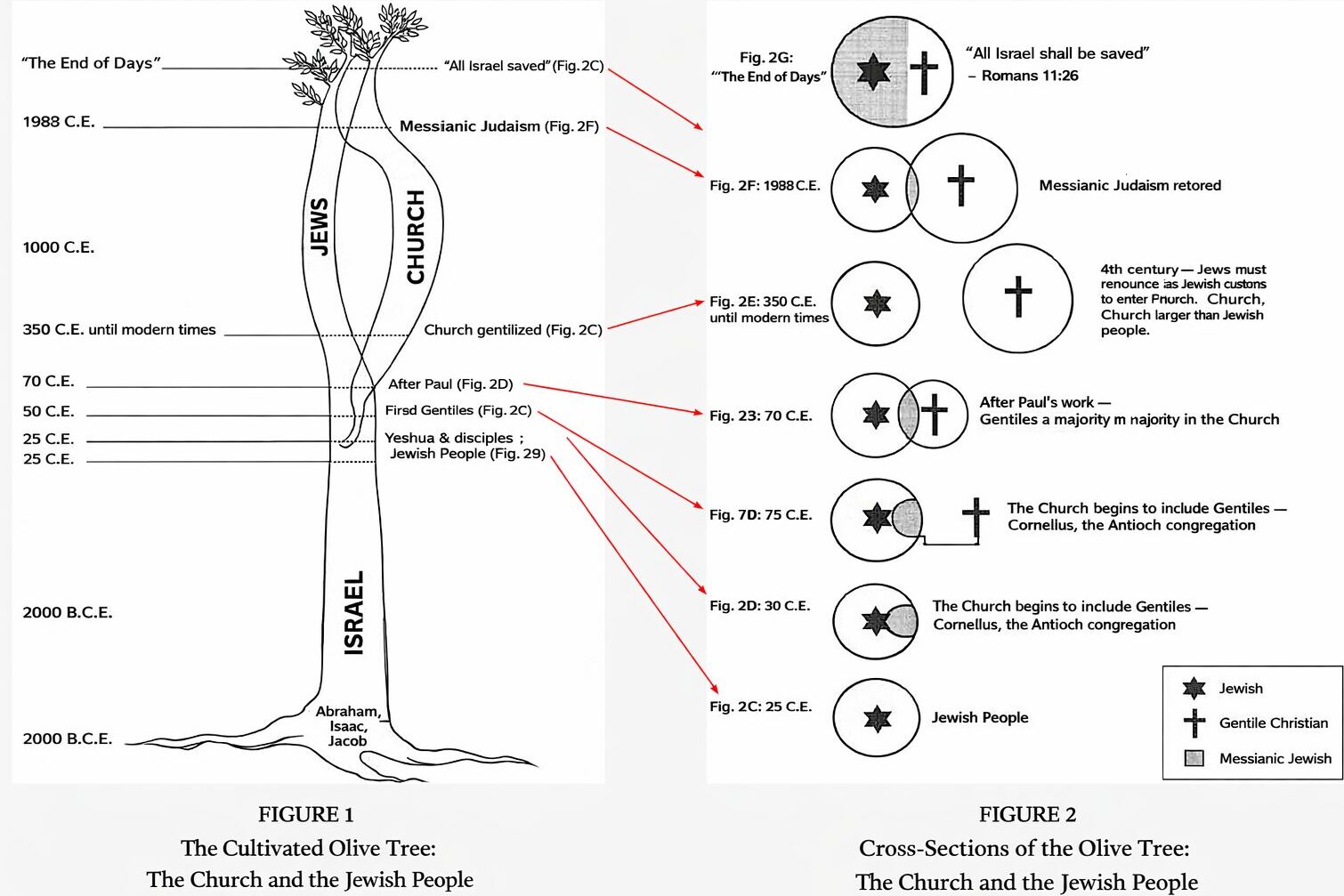
David H. Stern, Messianic Jewish Manifesto (Jerusalem: Jewish New Testament Publications, 1988).
Bibliography
- Suetonius, Domitian 12.2; Cassius Dio, Roman History 65.7.
- Suetonius, Domitian 12.2.
- Suetonius, Claudius 25.4.
- Tacitus, Annals 15.44.
- Justin Martyr, Dialogue with Trypho 17, in Ante-Nicene Fathers, vol. 1 (Peabody, MA: Hendrickson, 1994), 203.
- Justin Martyr, Dialogue with Trypho 16, 18; ANF 1:202–4.
- Irenaeus, Against Heresies 4.21.3; ANF 1:489.
- Eusebius, Life of Constantine 3.18.
Leave a Reply
You must be logged in to post a comment.