
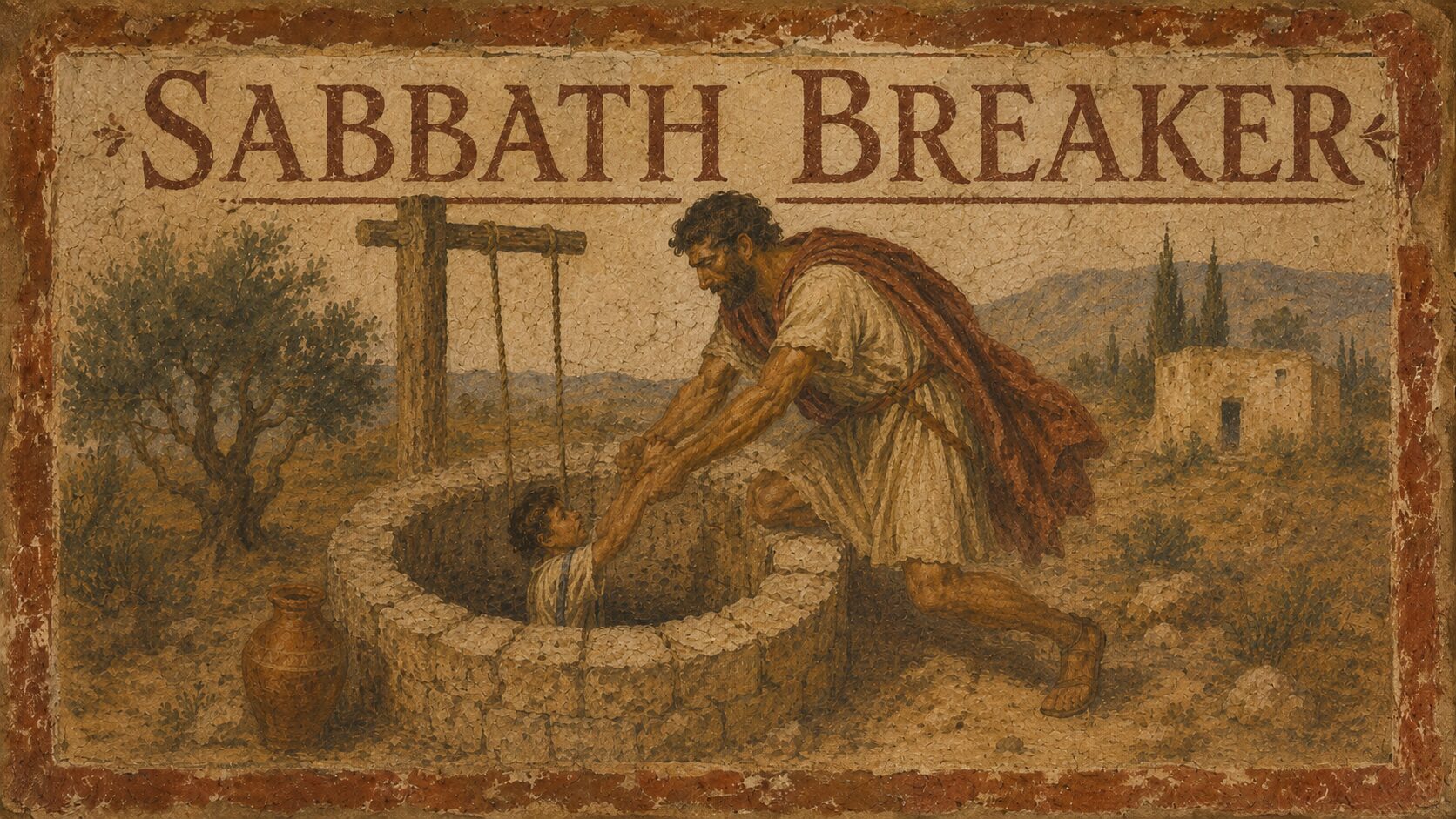
When reading through the Gospel accounts a reader is confronted with stories of other Jewish leaders (Pharisees and teachers of the law) challenging Jesus directly on his interpretation of Sabbath. Their challenge was that Jesus permitted His disciples, or performed Himself, actions they regarded as unlawful labor on the Sabbath.
Unfortunately, nearly two thousand years later, Jesus sometimes faces a similar challenge—now from some of His own disciples. Although few disciples would explicitly say that Jesus “broke the Sabbath,” since that would raise problems for Jesus’ sinlessness, the Sabbath stories are often read as if Jesus were opposing Judaism or dismissing the Torah. But in their first-century Jewish setting, these passages show Jesus participating in a Jewish discussion about how Sabbath should be kept when human need, mercy, healing, and covenant faithfulness are at stake. This issue is one of the most repeated ethical/torah central issues in the gospels and in this article we are going to ambitiously walk through all 7 distinct sabbath controversies found in the gospels (see appendix below) and see what those who questioned Jesus’ sabbath teachings said and how Jesus responds.
Before we begin, it is important to note that the Sabbath was not a human invention or a religious burden. God blessed the seventh day at creation (Genesis 2:2–3), commanded Israel to keep it holy (Exodus 20:8–11), and connected it to Israel’s memory of redemption from Egypt (Deuteronomy 5:12–15). Jesus faithfully participated in the sabbath customs and went to the synagogue on the Sabbath “as was His custom” (Luke 4:16 NASB) and can be seen as a sign of His faithfulness to Jewish custom and Torah-shaped life.1 Would Jesus have really broken or degraded the 4th commandment or instructed others to do the same?
The Sabbath Was Made for Man
This central Sabbath saying comes when Jesus’ disciples pluck grain on the Sabbath because they are hungry (Matthew 12:1–8; Mark 2:23–28; Luke 6:1–5). When challenged, Jesus does not depreciate the importance of the Sabbath.
He points to David in the scriptures, who ate the bread of the Presence when he and his men were hungry (1 Samuel 21:1–6). That bread was normally reserved for priests (Leviticus 24:5–9), yet David’s need mattered. Matthew adds another example: the priests labor in the Temple on the Sabbath and are “innocent” (Matthew 12:5 NASB; cf. Numbers 28:9–10). Jesus then quotes Hosea 6:6: “I desire compassion, and not a sacrifice” (Matthew 12:7 NASB).
In his interpretation Jesus uses the Torah to interpret the Torah. He argues that human need, mercy, and Temple service are weightier matters when commandments seem to overlap. Jesus’ point is that compassion for human suffering takes priority even over ceremonial concerns, because God desires mercy. Jesus’ arguments from David about the Sabbath’s purpose should be understood as fitting within ancient Jewish legal reasoning during the first century rather than depreciating the value of the sabbath or the Torah as these discourses were common in the second temple period.2
Later rabbinic tradition argues that saving life overrides Sabbath, and some traditions use David, Temple service, and circumcision as examples of commandments that can take precedence over Sabbath restrictions.3 The saying “the Sabbath was given to you; you were not given to the Sabbath” appears in Jewish tradition as well, showing how close Jesus’ reasoning was to a Jewish way of weighing commandments.4
Sabbath as a Day of Healing and Release
Following the same theme, In Mark 1:21–28 and Luke 4:31–37, Jesus teaches in the synagogue on the Sabbath and frees a man from an unclean spirit. Luke has already framed Jesus’ mission with Isaiah 61: “to proclaim release to captives” and “to set free those who are oppressed” (Luke 4:18 NASB). Because Sabbath is rooted not only in creation rest but also in Israel’s redemption from bondage, Jesus’ acts of healing and deliverance belong naturally to the day’s deepest purpose.
In Matthew 12:9–14, Mark 3:1–6, and Luke 6:6–11, Jesus heals a man with a withered hand. He asks, “Is it lawful to do good on the Sabbath or to do harm, to save a life or to kill?” (Mark 3:4 NASB). Matthew records His comparison to rescuing a sheep from a pit, concluding, “So then, it is lawful to do good on the Sabbath” (Matthew 12:12 NASB).
Luke gives two more examples. In Luke 13:10–17, Jesus heals a woman bent double for eighteen years and calls her “a daughter of Abraham” who should be “released from this bond on the Sabbath day” (Luke 13:16 NASB). In Luke 14:1–6, He heals a man with edema and asks whether one would rescue a son or an ox from a well on the Sabbath. Some Dead Sea Scrolls reflect stricter Sabbath rulings than the position Jesus takes, especially regarding rescue on the Sabbath. This helps us see that Jesus’ teaching belongs within a spectrum of Jewish Sabbath interpretation rather than outside Judaism altogether. 5
Jesus connects the sabbath back to Deuteronomy where the Sabbath is compared to Israel’s liberation from slavery (Deuteronomy 5:15). In Jesus’ teaching, healing is not a violation of Sabbath but a revelation of its purpose. Sabbath is not merely a day of ceasing from labor; it is a sign of restoration, liberation, and the coming world where suffering is undone.
John’s Sabbath Controversies
John gives us our last three major Sabbath conflicts. In John 5:1–18, Jesus heals a man disabled for thirty-eight years and tells him, “Get up, pick up your pallet and walk” (John 5:8 NASB). The objection concerns both healing and carrying the mat. Jesus responds, “My Father is working until now, and I Myself am working” (John 5:17 NASB). He is claiming that the Father’s life-giving work continues even on the sabbath, and the Son shares in that work.
In John 7:21–24, Jesus returns to this controversy with a Jewish legal argument. Circumcision is performed on the eighth day, even when that day falls on the Sabbath (Leviticus 12:3). If one part of the body may receive the covenant sign on Sabbath, Jesus asks, “are you angry with Me because I made an entire man well on the Sabbath?” (John 7:23 NASB). This is a common “lesser to greater” Jewish argument: if circumcision rightly takes precedence, how much more the restoration of a whole person?6
John 9 gives another Sabbath healing, this time of a man born blind. Jesus makes mud, anoints the man’s eyes, and sends him to wash (John 9:6–7, 14). For some Pharisees, this became a test of Jesus’ legitimacy: “This man is not from God, because He does not keep the Sabbath” (John 9:16 NASB). Yet the inter-Jewish dialogue continues, with others asking, “How can a man who is a sinner perform such signs?” (John 9:16 NASB). John presents the controversy not merely as a dispute over Sabbath labor, but as a debate over whether Jesus’ works reveal the life-giving activity of God.
Lord of the Sabbath
Jesus’ uses the Sabbath to teach his disciples about his own identity when he says “The Son of Man is Lord even of the Sabbath” (Mark 2:28 NASB). The Sabbath is a sign of creation, covenant, rest, mercy, and coming restoration. In Jesus, the blind see, the bound are released, the disabled walk, and the oppressed are lifted up (Isaiah 35:5–6; 61:1–2).
Why does it matter?
In the article we have seen through the Gospel Sabbath controversies Jesus connects the Sabbath with creation, covenant, mercy, human need, healing, release from bondage, and the Father’s life-giving work. He does not treat Sabbath as a meaningless ritual or an obstacle to compassion, but as a holy gift for rest, worship, restoration, and human flourishing. In His hands, Sabbath looks back to creation and Israel’s redemption, while pointing forward to the kingdom where the hungry are fed, the bound are released, the blind see, and the broken are made whole.
This does not mean every disciple must observe the Sabbath in the same covenantal way it was given to Israel. Sabbath is specifically called a sign of the Sinai covenant with Israel (Exodus 31:13–17), and the apostles did not require Gentile believers to take on the full covenantal yoke of Torah (Acts 15; Colossians 2:16–17; Romans 14:5–6). Yet Sabbath is not irrelevant. Every disciple needs its wisdom: rest instead of striving, mercy instead of hardness, restoration instead of bondage, and worship instead of self-rule.
Therefore, Jesus’ Sabbath controversies should not lead us to despise Sabbath, dismiss Torah, or caricature Jewish faithfulness. They teach us to listen to Israel’s Messiah as Lord of the Sabbath. He shows that God’s commandments are not opposed to mercy, and true holiness is never indifferent to suffering. Whether kept as Israel’s covenant sign or received as Messiah-shaped wisdom, Sabbath calls all disciples toward worship, rest, compassion, healing, and hope in the coming kingdom of God.
Appendix: The Seven Sabbath Controversies in the Gospels
The following chart lists the seven distinct Sabbath controversy scenes in the Gospels, counting repeated Synoptic accounts as one event and treating John 7:21–24 as a distinct Sabbath dialogue connected to the earlier healing in John 5.
| # | Sabbath Controversy | Scripture References | One-Sentence Summary |
|---|---|---|---|
| 1 | The disciples pluck grain on the Sabbath | Matthew 12:1–8; Mark 2:23–28; Luke 6:1–5 | Jesus defends His hungry disciples by appealing to David and the bread of the Presence, Temple service, mercy over sacrifice, and the principle that “the Sabbath was made for man.” |
| 2 | Jesus heals the man with the withered hand | Matthew 12:9–14; Mark 3:1–6; Luke 6:6–11 | Jesus challenges the Sabbath question by asking whether it is lawful to do good and save life on the Sabbath, then heals the man’s hand as an act of mercy. |
| 3 | Jesus heals the bent woman, “a daughter of Abraham” | Luke 13:10–17 | Jesus heals a woman bound by suffering for eighteen years and argues that Sabbath is a fitting day for covenant release and restoration. |
| 4 | Jesus heals the man with dropsy | Luke 14:1–6 | Jesus heals a suffering man on the Sabbath and reasons that if one would rescue a son or an ox from a well, mercy toward a person is surely lawful. |
| 5 | Jesus heals the disabled man at Bethesda and tells him to carry his mat | John 5:1–18 | Jesus heals a man disabled for thirty-eight years, tells him to carry his mat, and explains His Sabbath work as participation in the Father’s ongoing life-giving work. |
| 6 | Jesus defends Sabbath healing through circumcision | John 7:21–24 | Jesus argues that if circumcision may be performed on the Sabbath, then making an entire person well on the Sabbath accords with the deeper intent of Torah. |
| 7 | Jesus heals the man born blind by making mud | John 9:1–41 | Jesus gives sight to a man born blind on the Sabbath, prompting debate over whether His healing act violates Sabbath or reveals that He is from God. |
Footnotes
- Mark S. Kinzer, Jerusalem Crucified, Jerusalem Risen: The Resurrected Messiah, the Jewish People, and the Land of Promise (Eugene, OR: Cascade, 2018), on Luke 4:16. ↩︎
- Daniel Boyarin, The Jewish Gospels: The Story of the Jewish Christ (New York: The New Press, 2012). ↩︎
- m. Yoma 8:6; cf. t. Šabb. 15:16; Mek. R. Ishmael, Šabbata 1. ↩︎
- Mek. R. Ishmael, Šabbata 1; cf. Mark 2:27. ↩︎
- Damascus Document 11.13–14; m. Šabb. 7:2. ↩︎
- Amy-Jill Levine, The Misunderstood Jew: The Church and the Scandal of the Jewish Jesus (New York: HarperOne, 2006). ↩︎
Leave a Reply
You must be logged in to post a comment.