
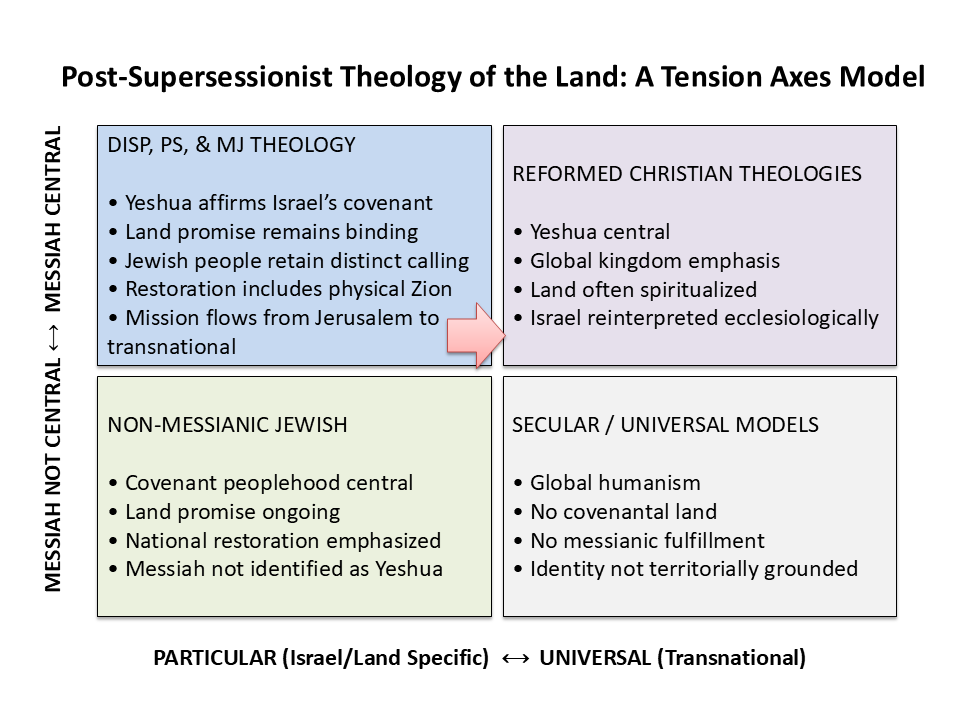
Modern Zionism means different things depending on who is speaking. It is most commonly described as a political movement focused on Jewish national sovereignty in the land of Israel. Biblical Zionism, however, is a theological conviction that God’s covenant promises to Israel—including the land—remain valid and ultimately find their fulfillment in the reign of the Messiah. While these perspectives often overlap in important ways, they are not identical. What follows is a broad overview of several major perspectives on modern Zionism and the theology of the land.
The conversation at its core, it asks: What do God’s promises about Zion—the land, Jerusalem, and Israel—mean today? The differences usually come down to two questions: Are those promises fulfilled in a particular way (To specific people and land outlined in God’s promises (Gen 12:7; 15:18–21, Deut 30:1–5; Ezek 36:8, 24)) or a universal way (The land becomes symbolic of the whole world (Romans 4:13 is often read this way))? And are they fulfilled in a messianic way by Yeshua or apart from Yeshua the Messiah?
Orthodox Judaism treats the land as inseparable from the covenant. Genesis 17:8 calls it an “everlasting possession,” and Deuteronomy 30:1–5 promises return after exile. Rabbinic tradition reinforces this; the Talmud (Ketubot 110b) says dwelling in the land is equal to all the commandments. The promises are particular and territorial. Yet Orthodoxy divides over timing. Religious Zionists see the modern return as the “beginning of redemption” (echoing Ezekiel 36:24), while some ultra-Orthodox groups appeal to the “Three Oaths” (Ketubot 111a) and insist that sovereignty must wait for Messiah and any return to the land without the Messiah represents an attempt to force redemption ahead of God’s timing. For both, restoration must ultimately be messianic—but they disagree about whether it can begin before his arrival. Orthodox Judaism, while connecting the redemption to the Messiah but it does not recognize Yeshua as the Davidic king through whom that restoration begins and ultimately culminates (Jeremiah 31:31–34; Ezekiel 37:24–28; Isaiah 2:2–4). As a result, its theology of the land remains covenantal and messianic in hope, but not centered on the Messiah who has already come and will return. For those who follow Yeshua, the land is inseparably bound to His messianic identity and reign. He is the son of David (2 Samuel 7:12–16; Luke 1:32–33). He is the one who will reign from Zion (Psalm 2; Zechariah 14:9). The restoration of Israel, the ingathering of the exiles, and the peace of Jerusalem ultimately find their coherence in Him.
2) Secular Zionism, by contrast, is particular but non-messianic. Emerging in the late 19th century, it focused on Jewish survival, dignity, and national self-determination in the face of growing antisemitism. The land was essential—not because of covenant promise, but because it offered political refuge and national restoration. Redemption, in this framework, was political rather than prophetic. Leading secular Zionists included Theodor Herzl, often called the father of modern political Zionism, along with figures such as David Ben-Gurion and Chaim Weizmann. The movement also depended heavily on the support of international leaders like Arthur James Balfour, Woodrow Wilson, Winston Churchill, and Harry S. Truman. Without their diplomatic backing and recognition, the modern State of Israel might not exist today.
3) Reformed Christian theology has often taken a different path. While affirming fulfillment in Messiah, it tends to universalize the land promises. Romans 4:13 speaks of Abraham inheriting “the world,” and Hebrews 12:22 describes a heavenly Zion. In this reading, the territorial promise becomes a shadow of new creation. Fulfillment is messianic—but not tied to a specific geography. The land is absorbed into a global or spiritual reality.
4) There is a broad stream of theology that includes both Evangelical dispensationalism, Post-supersessionist Christian, and Messianic Jewish thought. While they differ in structure and emphasis, both affirm that God’s promises to Israel remain particular and territorial. Genesis 15:18–21 still refers to a real land. Ezekiel 36:24 still speaks of a real regathering. Romans 11:29 still declares that God’s gifts and calling are irrevocable. These traditions resist dissolving Israel’s covenant into abstraction or redefining the land into a mere metaphor.
At the same time, they emphasize that the promise was never meant to remain isolated or ethnically closed. From the beginning, the covenant included the nations: “In you all the families of the earth shall be blessed” (Genesis 12:3). The prophets envision the nations streaming to Zion under Messiah’s reign (Isaiah 2:2–4). Dispensationalism often maintains a sharper distinction between Israel and the Church, while Messianic Jewish and Post-supersessionist theology stress one integrated covenant story in which Gentiles are grafted into Israel’s promises (Romans 11:17–24). Yet both occupy the space between the particular and the universal—affirming a covenant rooted in a specific people and land that ultimately expands to bless all nations under the Messiah.
In very broad generalizations, some of the main perspectives can be summarized as follows:
- Secular Zionism is particular but non-messianic.
- Reformed theology is messianic but often universalized.
- Orthodox Judaism is particular and messianic, divided on timing, but does recognize the land promises coming through Yeshua the Messiah.
- Dispensationalism, Messianic Judaism, and post-supersessionist theology all seek to uphold the particular promises to Israel while affirming their universal expansion, covenant continuity, and ultimate fulfillment in Yeshua.
Leave a Reply
You must be logged in to post a comment.