
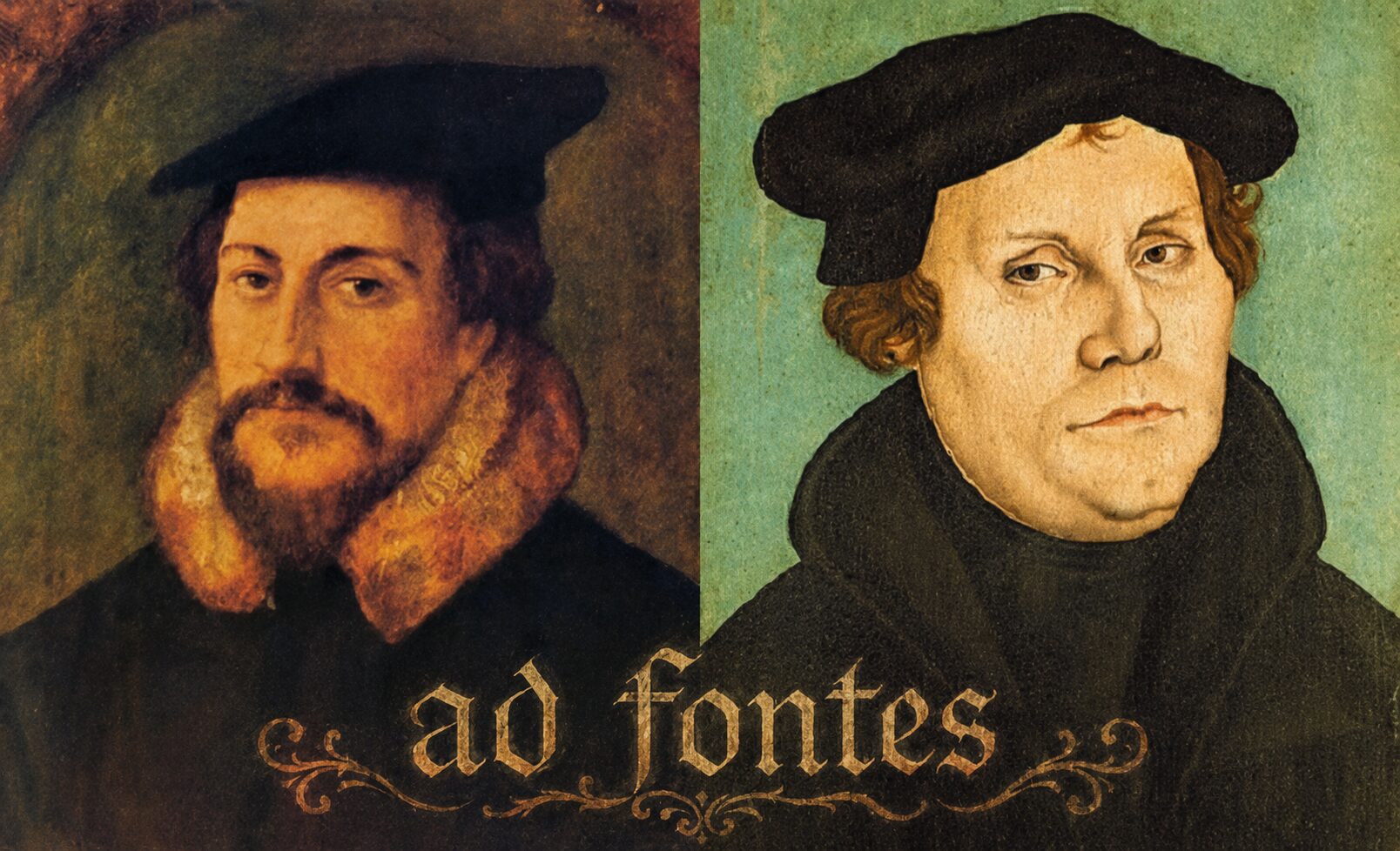
Ad fontes means “to the sources.” It was one of the great cries of the Renaissance and Reformation. Humanists and Reformers believed that renewal required returning to the earliest witnesses rather than relying only on inherited interpretations. For the Reformers, this meant returning to Scripture in its original languages—Hebrew and Greek—so the church could hear the Word of God with greater clarity.
For Reformers like Luther and Calvin, ad fontes meant:
- Translate Scripture directly from Hebrew and Greek.
- Question doctrines not clearly rooted in the earliest textual sources.
- Evaluate medieval traditions against Scripture itself.
So instead of:
Bible → Church tradition → Theology
They argued for:
Original text → Theology → Church practice
Honoring the Reformers
We should honor that courage. The Reformers were not simply trying to rebel against tradition. At their best, they were seeking to recover the authority of Scripture. They believed, as Paul wrote, that “All Scripture is inspired by God and beneficial for teaching, for rebuke, for correction, for training in righteousness” (2 Timothy 3:16 NASB). Their goal was to be faithful to the original scripture.
Yet if we honor the Reformers well, we should not freeze ad fontes in the sixteenth century. We should carry its best impulse forward, we should carry on the critical thinking principles that they had. Paul encourages the Berean Jews in the book of acts saying that they “were of more noble character than those in Thessalonica, for they received the message with great eagerness and examined the Scriptures every day to see if what Paul said was true” (Acts 17: 10-11). In the information age today, it becomes even more critical to apply critical thinking and compare everything you are taught “back to the sources”.
Critical thinking is difficult because all of us are tempted to protect what we already believe. When Scripture challenges an inherited framework, we may feel cognitive dissonance—the discomfort of holding two things together that do not easily fit. In that moment, the danger is to resolve the tension too quickly by forcing the text back into our existing system. But the Bereans model a better way: they allowed Scripture to examine even trusted teaching before accepting it.
More Than Original Languages
Going “back to the sources” is more than than reading Scripture in Hebrew and Greek. To understand Scripture well, we need to ask not only what a word means, but what assumptions, images, customs, and hopes surrounded it.
The Bible was not written in a vacuum. The Torah emerged within the ancient Near Eastern world. The Prophets spoke to Israel in covenant, exile, judgment, and hope. The Gospels were written in the world of Second Temple Judaism under Rome. Paul wrote as a Jewish apostle to the Gentiles, proclaiming Israel’s Messiah among the nations. Revelation speaks with the language of Israel’s prophets, Temple imagery, and Jewish apocalyptic hope.
So true ad fontes today includes the historical, cultural, and Jewish context of Scripture. It means hearing Jesus, Paul, Peter, John, and James within the world they actually inhabited.
When Jesus announced, “The time is fulfilled, and the kingdom of God is at hand; repent and believe in the gospel” (Mark 1:15), He was not offering a vague religious slogan. He was speaking into Israel’s hope for God’s reign, restoration, forgiveness, justice, and final redemption. When John says, “In the beginning was the Word” (John 1:1), he is drawing us back to Genesis, creation, divine wisdom, and God’s self-revelation. When Paul says Gentile believers are “fellow heirs and fellow members of the body” in Messiah (Ephesians 3:6), he is announcing that the nations have been graciously grafted into Israel’s Messiah.
The Sources We Now Have
The Reformers had access to Scripture, the biblical languages, the church fathers, and some ancient sources. But they did not have what we now have: the Dead Sea Scrolls, many archaeological discoveries, wider access to Second Temple Jewish literature, early manuscripts, inscriptions, Roman historical material, and a much richer understanding of ancient Jewish life.
These sources do not stand above Scripture. They are not Scripture’s master. They are servants that help us understand the world behind the text.
That historical and cultural context deepens our understanding of the Bible. For example, Pentecost in Acts 2 is not merely a surprising spiritual event; it happens during Shavuot, a Jewish festival that brings it’s own history of the giving of God’s instruction. The Lord’s Supper is not merely a Christian ritual; it is rooted in Passover, covenant, redemption, and kingdom hope that parallels the life and message of our Messiah (Luke 22:14–20).
Opportunity, Not Threat
For some Christians, historical context can feel threatening, as though learning more about the world of Scripture might weaken faith. But rightly used, context does the opposite. It makes the Bible more vivid, not less inspired. It helps us see connections we missed. It teaches us to read slowly, carefully, and humbly.
This renewed ad fontes is not a call for every believer to become a Hebrew or Greek scholar. Nor is it a rejection of all tradition. Tradition can be a gift. Creeds, confessions, hymns, sermons, and theological writings often preserve wisdom from generations before us. We should not despise the church’s memory.
At the same time, inherited tradition can become so familiar that it feels identical to Scripture itself. When that happens, we may read defensively, looking only for confirmation rather than correction. A humble return to the sources helps us distinguish between what Scripture actually says and what our theological habits have taught us to expect it to say.
When tradition helps us see the text more clearly, we receive it with gratitude. When it is not open to “going back to the sources” and doesn’t allow us to approach theology with humility and an open mind, then it can be an obstacle for the same thought processes that the Reformers and Paul (Acts 11) advocated for.
This is not a call to reject tradition, but It is a call to humility, discernment, and application of critical thinking.
Scripture Must Shape Us
Every Christian tradition has commentary. Some of it is written in books. Some of it is hidden in sermons, songs, assumptions, and phrases we repeat without examination. The question is not whether we have traditions. We all do. The question is whether we will let Scripture correct them in humility.
Paul tells believers, “Do not be conformed to this world, but be transformed by the renewing of your mind” (Romans 12:2 NASB). That renewal includes learning to read Scripture on its own terms before forcing it into our inherited categories. It means allowing the Torah, Prophets, Writings, Gospels, Acts, Epistles, and Revelation to speak together as one unfolding story.
If we listen well, are slow to pass judgement, approach tradition and theology with humility comparing them “back to the sources”, though challenging it can be done, and is a fruitful experience!
Back to the Sources, Forward in Faithfulness
In a postmodern world, many people distrust authority, institutions, and inherited claims. Christians do not need to fear honest questions. We believe God has spoken. We believe Scripture is true. And because we believe that, we should be willing to examine whether our interpretations have truly listened to the text.
True ad fontes today means returning not only to Hebrew and Greek, but also to the original historical and Jewish context of Scripture. It means honoring the Reformers by continuing their best instinct: letting Scripture, not inherited commentary alone, reform the people of God.
We return to the sources so we may know Jesus the Messiah more truly, worship the God of Israel more reverently, love our neighbors more concretely, and walk by the Spirit more obediently.
Honest questions do not weaken biblical faith. What weakens faith is refusing to ask whether we have confused Scripture with our preferred reading of Scripture. A worldview that can only confirm itself, and never be corrected by the text, is not being shaped by Scripture.
“Back to the sources” is not merely a backward-looking slogan. It is a call to let Scripture, in its own world and by the power of the Holy Spirit, shape the church again.
Leave a Reply
You must be logged in to post a comment.