
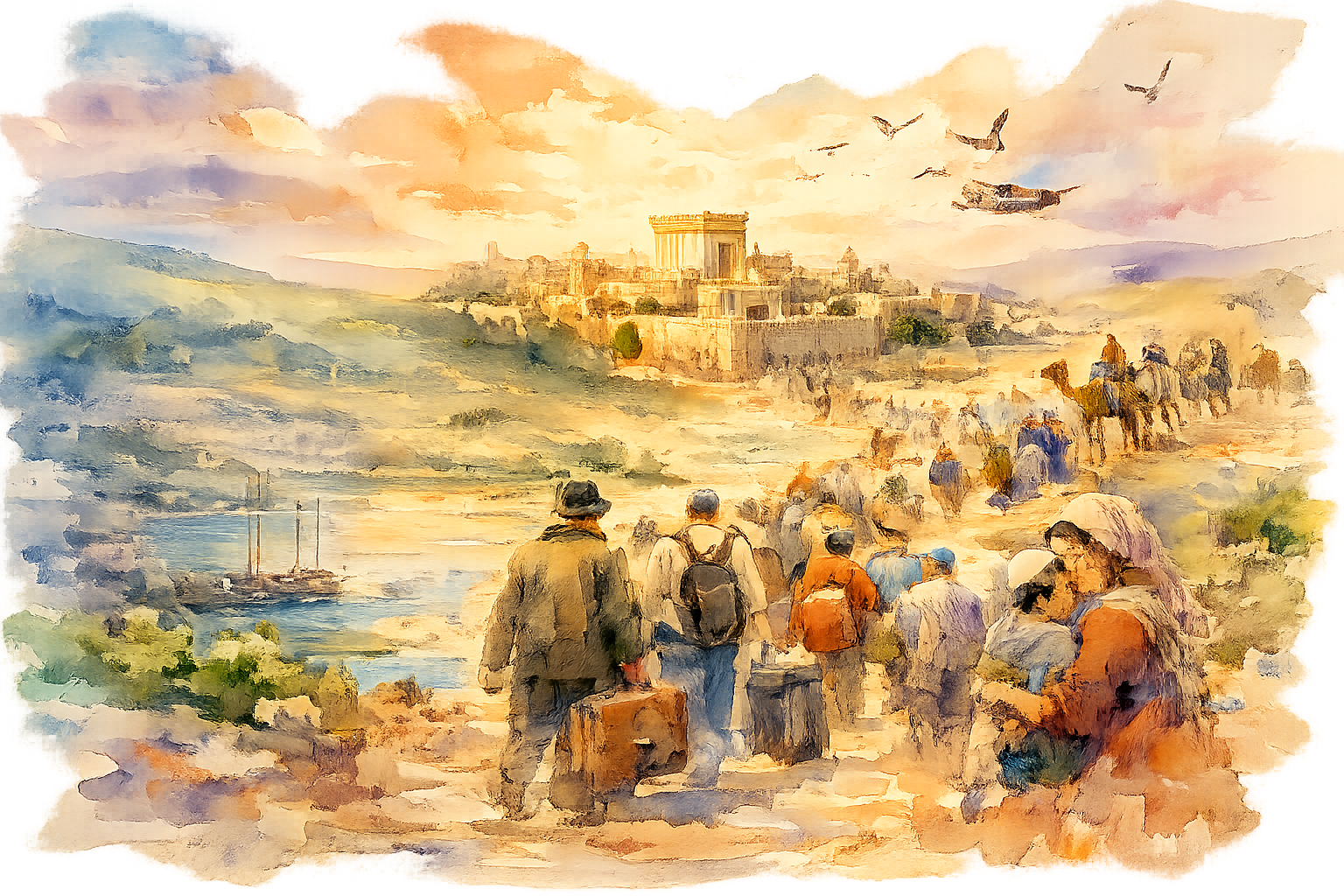
In the modern world, “Zionism” is usually understood as a political movement connected to Jewish national self-determination and the modern State of Israel. People tend to argue about it in political categories—borders, governments, parties, wars—so the word can feel like it automatically belongs to the news cycle. This post discusses “Biblical Zionism”, a term that describes God’s connection to the Land, and his promises to his people that the land will be a part of the return from exile and the eventual redemption. If you want to learn more about the modern political Zionism Movement, or about the modern State of Israel you can check out my other articles on those topics. “Biblical Zionism,” though, is not a political platform. It’s simply taking Scripture seriously when it speaks about Zion: a real place God chose, a real people God covenanted with, and a real future in which the Messiah reigns and the nations are blessed through what God does in and from Jerusalem.
In Scripture, Zion is first a concrete location. It is David’s stronghold and the heart of Jerusalem (2 Samuel 5:7). It is “the city of our God… Mount Zion… the city of the great King” (Psalm 48:1–3). It is the place God “has chosen” as His dwelling (Psalm 132:13–14). Zion can refer narrowly to the hill or broadly to Jerusalem, and sometimes even to Israel as a people, but the thread tying these uses together is that Zion is where God locates His Name, His kingship, and His worship in history.
Zion is also future-facing. The prophets describe a day when God restores His people, renews Jerusalem, and makes Zion a global center of worship and instruction. Isaiah pictures the nations streaming up to learn God’s ways: “For out of Zion shall go forth the law, and the word of the LORD from Jerusalem” (Isaiah 2:2–4). Zechariah speaks of many peoples coming to seek the Lord in Jerusalem (Zechariah 8:20–23). This is not Zion as a private spiritual symbol; it is Zion as the meeting point between heaven’s rule and earth’s reality.
That is why we cannot remove the land from God’s promises to Israel without doing damage to the story of Scripture itself. From the beginning, God binds covenant to geography. He calls Abraham to a land and promises, “To your offspring I will give this land” (Genesis 12:1, 7). The land is not an illustration; it is part of the covenant structure. When Israel is exiled, it is exile from the land (Leviticus 26; Deuteronomy 28). When God promises restoration, it is restoration to the land (Deuteronomy 30:1–5). The prophets speak to the “mountains of Israel” and promise that they will again bear fruit because God will bring His people home (Ezekiel 36:8). If we detach the land from these promises, we are not simplifying theology—we are rewriting it.
When we “deterritorialize” the promises, we subtly reshape the character of God. If the land becomes only a metaphor, then the covenant with Abraham becomes abstract. If Jerusalem becomes only a symbol of heaven, then God’s oath-bound faithfulness in history becomes negotiable. But Scripture presents a God who keeps His word in time and space. He stakes His reputation on restoring Israel “for the sake of my holy name” (Ezekiel 36:22–24). A God who spiritualizes away concrete promises when they become difficult is not the God revealed in the Torah and the Prophets.
The New Testament does not cancel this. After the resurrection, the disciples ask Yeshua about restoring the kingdom to Israel (Acts 1:6). He does not correct the premise of their hope; He redirects their understanding of timing and sends them outward—from Jerusalem to the ends of the earth (Acts 1:7–8). The mission expands, but it does not erase Zion. Paul reinforces this when he insists that the gifts and calling of God to Israel are irrevocable (Romans 11:29). Gentile believers are grafted into Israel’s story, not inserted as a replacement for it (Romans 11:17–24).
Why does this matter for us as disciples of Messiah? Because if we train ourselves to reinterpret God’s promises whenever they feel inconvenient, we weaken our confidence in every promise. The same God who pledged a land to Abraham pledged resurrection life in Messiah. The same God who promised to gather Israel promises to complete the work He began in us. Zion is not a political talking point; it is a testimony that God is faithful in history. And that faithfulness anchors our hope.
Biblical scholars across the theological spectrum have recognized that the land is not a detachable metaphor. Walter Brueggemann famously called land ‘a central, if not the central theme of biblical faith.’ Christopher Wright similarly argues that the land is woven into Israel’s covenant vocation. Even theologians who differ politically acknowledge that the promises to Abraham are territorially defined (Genesis 12:7; 15:18–21). The question is not whether the land matters in Scripture — it clearly does — but how those promises unfold in Messiah
Biblical Zionism, then, is not about baptizing every political decision or confusing theology with policy. It is about confessing that God’s covenant with Israel includes a land, that Jerusalem has a role in His redemptive plan, and that the Messiah will reign in a way that brings real peace to a real world. If we remove the land from the promises, we do not make the gospel more spiritual—we make it less trustworthy.
Zion matters because it testifies that God’s kingdom is not an escape from the world, but God’s reign coming into the world—ultimately through the Messiah, when Jerusalem becomes a place of joy, justice, and worship for all peoples (Isaiah 2:2–4; Psalm 48:1–3).
Bibliography:
Brueggemann, Walter. The Land: Place as Gift, Promise, and Challenge in Biblical Faith. 2nd ed. Minneapolis: Fortress Press, 2002.
Wright, Christopher J. H. The Mission of God: Unlocking the Bible’s Grand Narrative. Downers Grove, IL: InterVarsity Press, 2006.
McDermott, Gerald R. Israel Matters: Why Christians Must Think Differently about the People and the Land. Grand Rapids: Brazos Press, 2017.
Rosner, Jennifer M. “The Land in Messianic Jewish Covenant and the People of God.” In Covenant and the People of God: Essays in Honor of Jonathan Sacks, edited by Jonathan Kaplan, 2023.
McDermott, Gerald R., ed. The New Christian Zionism: Fresh Perspectives on Israel and the Land. Downers Grove, IL: InterVarsity Press, 2016.
Leave a Reply
You must be logged in to post a comment.