
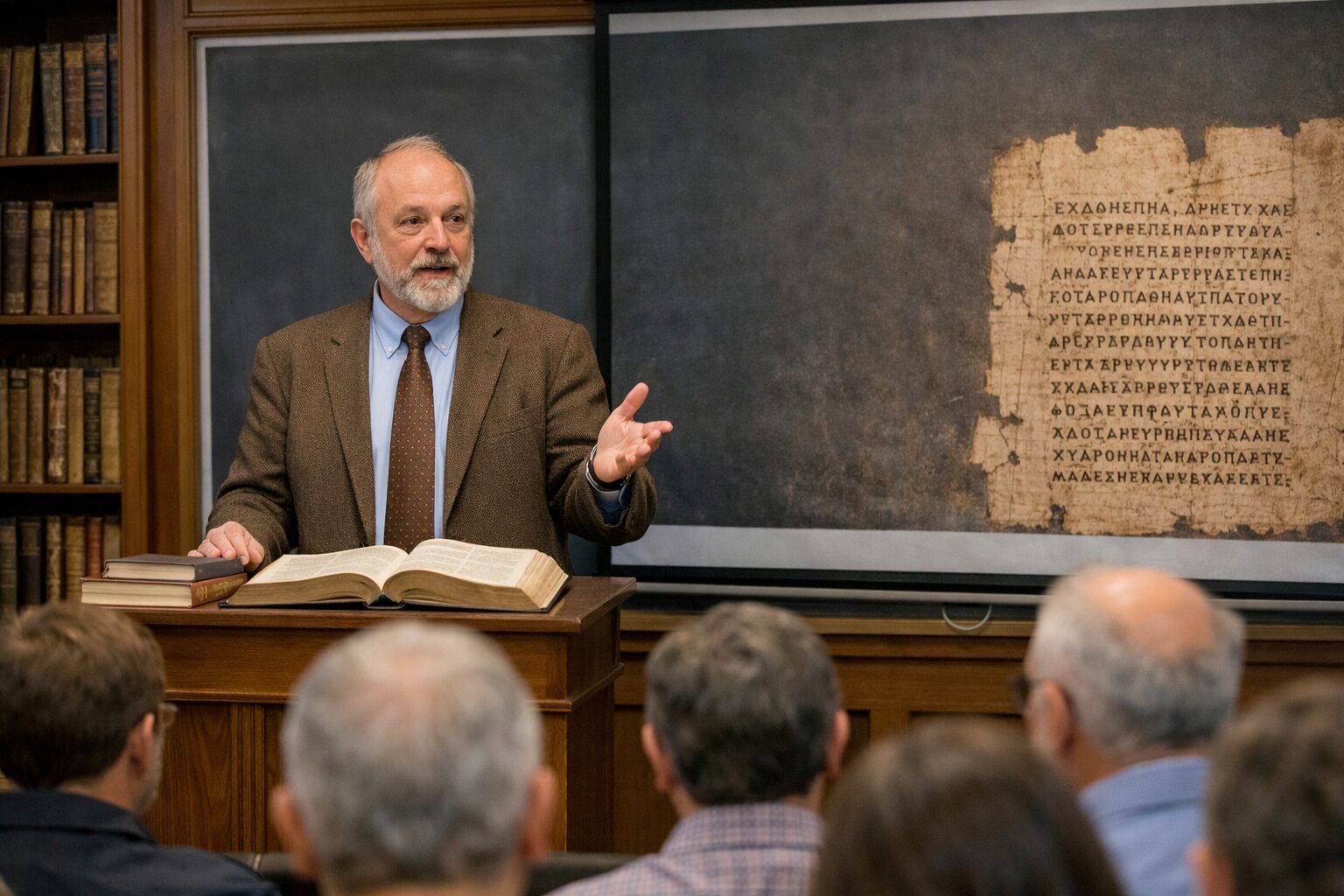
Survey of Modern New Testament Scholarship and the Formation of “Paul within Judaism” Thought.
Paul has rarely suffered from a lack of attention. If anything, the problem has been the opposite: because Paul’s letters are dense, technical, and sometimes “hard to understand” (2 Pet 3:16), Christians have repeatedly pulled him out of his first-century world and made him speak whatever later debates required, much of this stemming from The Parting of The Ways. That vulnerability shows up early, from forged “Pauline” claims (2 Thess 2:2) to second-century figures like Marcion, who pitted the God of Israel against the Father of Jesus by appealing to a selective reading of Paul.¹
Yet Paul, by his own testimony, does not present himself as an ex-Jew who found a new god. He identifies as “a Hebrew of Hebrews” and a Pharisee (Phil 3:5), and in Luke’s narrative he locates his hope in “the promise made by God to our fathers” (Acts 26:6). He expects the resurrection of the dead, final judgment, and the kingdom—shared convictions that make sense inside late Second Temple Jewish discourse. The scholarly question, then, is not whether Paul has distinctive claims (he certainly does), but whether those claims are best read as a departure from Judaism or as an argument made from within Judaism about Israel’s Messiah and Israel’s God.
Modern scholarship’s path toward “Paul within Judaism” did not begin with Paul. It began with the broader recognition that Jesus, too, must be read in his Jewish setting. In the late nineteenth century Johannes Weiss argued that Jesus’ “kingdom of God” language should not be reduced to moral uplift or an ideal society; it belongs to Jewish expectation of God’s climactic reign, bound up with judgment and restoration.² Albert Schweitzer pressed the point further by portraying Jesus as an apocalyptic prophet of Israel’s end-time hope, even if Schweitzer himself judged Jesus’ expectation mistaken.³ Whatever one makes of their theological conclusions, they forced the historical question into the center: the New Testament is saturated with Jewish apocalyptic hopes.
That recognition triggered a countermovement in early twentieth-century English-language scholarship. C. H. Dodd argued that Jesus’ kingdom proclamation is “realized” in his ministry and the church’s life, not merely future expectation.⁴ Oscar Cullmann then helped frame the discussion with his influential “already/not yet” model, describing Christian time as inaugurated but not consummated.⁵ This debate about eschatology mattered because it shaped how scholars would later hear Paul: was Paul essentially announcing an imminent cosmic intervention, or interpreting a decisive divine act already inaugurated in Messiah?
At mid-century, the challenge sharpened when Rudolf Bultmann argued that Jewish apocalyptic language is “mythological” for modern people and must be “demythologized.”⁶ In the post–World War II German context, Ernst Käsemann’s famous pushback insisted that apocalyptic is not disposable packaging but belongs to the substance of earliest Christian proclamation.⁷ That recovery helped re-center the Jewish apocalyptic horizon that Paul assumes when he speaks of the “day,” the “appearing,” the judgment, and the kingdom (e.g., 2 Tim 4:1, 8). It also set the stage for a more focused project: if Jesus belongs in Judaism, then Paul must be located there too.
A major bridge into that Paul-centered task was J. Christiaan Beker, whose work emphasized Paul’s coherent apocalyptic “center” and argued that Paul’s theology must be read against Judaism’s eschatological framework rather than against abstract, later doctrinal questions.⁸ From there, two large trajectories dominated late twentieth-century Pauline studies. One stream developed what became known as the “apocalyptic Paul,” often associated with strong readings of divine invasion and deliverance from cosmic powers; J. Louis Martyn’s commentary on Galatians is a widely cited expression of that approach, emphasizing God’s apocalyptic rescue in Christ.⁹ The other stream emerged as the “New Perspective on Paul,” driven by a different dissatisfaction—namely, the traditional Protestant story that Paul’s opponents were Jewish “legalists” trying to earn salvation.
That older story was decisively unsettled by E. P. Sanders. In Paul and Palestinian Judaism, Sanders argued that much Second Temple Judaism fits a pattern he called “covenantal nomism”: God’s gracious covenant creates the relationship, and Torah functions within that covenant, not as a ladder to earn it.¹⁰ James D. G. Dunn then coined and popularized “the New Perspective on Paul,” arguing that Paul’s phrase “works of the law” in texts like Galatians addresses boundary-marking practices (especially circumcision, food, and calendar) that distinguished Jews from Gentiles, rather than a generic system of moral striving.¹¹ N. T. Wright carried these themes into a sweeping retelling of Paul in relation to Israel’s covenant story, justification, and the unity of Jews and Gentiles in Messiah.¹² For many Gentile Christians, this was a necessary correction: Paul’s sharpest arguments are often about how Gentiles are included in the God of Israel’s people, not about how Jews failed at self-salvation.
But the New Perspective did not satisfy everyone. A growing group of scholars argued that it still often produced a Paul who is not quite a Jew—because it continued to treat “Judaism” primarily as background, or as a problem to be overcome, rather than as Paul’s ongoing lived identity and interpretive world. Long before the label “Paul within Judaism” became common, several voices were already pushing in this direction. Lloyd Gaston argued for reading Paul in continuity with Israel’s Torah and against anti-Jewish caricatures.¹³ John Gager, from a different angle, contended that Paul’s critique is aimed at Gentile idolatry and the Gentile condition, not at Israel as such.¹⁴ Stanley Stowers strengthened the methodological foundations by reading Romans as an occasional letter that addresses Gentile addressees and their relationship to Jews and to Jewish communal life, rather than as a timeless systematic theology written over the heads of actual communities.¹⁵
These streams converged into what came to be identified explicitly as “Paul within Judaism,” signaled especially by the 2015 volume edited by Mark D. Nanos and Magnus Zetterholm.¹⁶ The title itself is a thesis: Paul is best located within Judaism—within Jewish scripture, Jewish categories, Jewish hopes, and Jewish communal realities—even as he proclaims astonishing claims about Israel’s Messiah, the gift of the Spirit, and the end-time turning of the nations to Israel’s God.
Nanos had already modeled this kind of reading by arguing that Romans should be heard within a Jewish communal context in Rome, pushing against the assumption that Paul writes as a detached founder of a new religion.¹⁷ Zetterholm likewise helped map how recent scholarship has been rethinking Paul’s relation to Judaism and why older binaries (“Judaism vs. Christianity”) distort the first-century picture.¹⁸ In this same orbit, Paula Fredriksen has been especially influential for portraying Paul as an apocalyptic Jewish missionary who expects the nations’ turning as part of Israel’s end-time horizon and who remains oriented toward Israel’s God and Israel’s promises.¹⁹ Matthew Novenson has helped readers recover how thoroughly Jewish “messiah/Christ” language is, resisting interpretations that treat christos as if it were merely a last name stripped of its Jewish meaning.²⁰ Matthew Thiessen, focusing on circumcision and Gentile status, has argued that Paul’s claims can be read within Jewish debates about whether Gentiles can or should become Jews, thus reframing key Pauline arguments as intra-Jewish reasoning about Gentiles rather than a rejection of Judaism.²¹
When you step back, the emergence of “Paul within Judaism” is not a sudden novelty so much as the ripening of several long-running correctives. Weiss and Schweitzer helped force the Jewish-apocalyptic setting back into view for Jesus. Dodd and Cullmann framed the debate over how that setting relates to Christian confession. Bultmann provoked the question of whether Jewish-apocalyptic thought could be taken seriously at all, and Käsemann helped reassert that it is central to the earliest message. Beker, Martyn, and others intensified the focus on Paul’s eschatological horizon. Sanders, Dunn, and Wright dismantled simplistic “legalism” narratives and relocated Paul’s controversies in the Jewish-Gentile problem. And then Nanos, Zetterholm, Fredriksen, Novenson, Thiessen, Stowers, Gaston, and Gager (among others) pressed the next step: Paul’s “Jewish context” is not merely a backdrop—it is Paul’s continuing home. This scholarly development helped pave the way of the rebirth of the Messianic Judaism movement in the twentieth century.
For Gentile disciples today, that matters spiritually as much as academically. Paul’s letters repeatedly warn Gentiles against arrogance toward Jews and call them to remember that they have been grafted into Israel’s olive tree rather than planted as a replacement (Rom 11:17–24, 29). Reading Paul within Judaism does not flatten the gospel into “more Judaism,” nor does it deny the real novelty of Messiah’s death and resurrection or the Spirit’s gift. It does, however, train Gentile believers to hear Paul as he intended: an apostle to the nations announcing that the God of Israel is being faithful to Israel—and extending mercy outward to the Gentiles, not to erase Israel’s story, but to draw the nations into worship of Israel’s God through Israel’s Messiah (Rom 15:8–12).
Bibliography
- Adolf von Harnack, Marcion: The Gospel of the Alien God, trans. John E. Steely and Lyle D. Bierma (Durham, NC: Labyrinth Press, 1990).
- Johannes Weiss, Jesus’ Proclamation of the Kingdom of God, trans. Richard H. Hiers and David L. Holland (Philadelphia: Fortress Press, 1971).
- Albert Schweitzer, The Quest of the Historical Jesus: A Critical Study of Its Progress from Reimarus to Wrede, trans. W. Montgomery (London: A. & C. Black, 1910).
- C. H. Dodd, The Parables of the Kingdom (London: Nisbet, 1935).
- Oscar Cullmann, Christ and Time: The Primitive Christian Conception of Time and History, trans. Floyd V. Filson (Philadelphia: Westminster Press, 1964).
- Rudolf Bultmann, “New Testament and Mythology,” in Kerygma and Myth: A Theological Debate, ed. Hans-Werner Bartsch, trans. Reginald H. Fuller (New York: Harper & Row, 1961), 1–44.
- Ernst Käsemann, “The Beginnings of Christian Theology,” in New Testament Questions of Today, trans. W. J. Montague (Minneapolis: Fortress Press, 1969), 82–107 (orig. pub. 1960).
- J. Christiaan Beker, Paul the Apostle: The Triumph of God in Life and Thought (Philadelphia: Fortress Press, 1980).
- J. Louis Martyn, Galatians: A New Translation with Introduction and Commentary (AB 33A; New York: Doubleday, 1997).
- E. P. Sanders, Paul and Palestinian Judaism: A Comparison of Patterns of Religion (Philadelphia: Fortress Press, 1977).
- James D. G. Dunn, “The New Perspective on Paul,” Bulletin of the John Rylands University Library of Manchester 65 (1983): 95–122.
- N. T. Wright, What Saint Paul Really Said: Was Paul of Tarsus the Real Founder of Christianity? (Grand Rapids: Eerdmans, 1997).
- Lloyd Gaston, Paul and the Torah (Vancouver: University of British Columbia Press, 1987).
- John G. Gager, Reinventing Paul (Oxford: Oxford University Press, 2000).
- Stanley K. Stowers, A Rereading of Romans: Justice, Jews, and Gentiles (New Haven: Yale University Press, 1994).
- Mark D. Nanos and Magnus Zetterholm, eds., Paul within Judaism: Restoring the First-Century Context to the Apostle (Minneapolis: Fortress Press, 2015).
- Mark D. Nanos, The Mystery of Romans: The Jewish Context of Paul’s Letter (Minneapolis: Fortress Press, 1996).
- Magnus Zetterholm, Approaches to Paul: A Student’s Guide to Recent Scholarship (Minneapolis: Fortress Press, 2009).
- Paula Fredriksen, Paul: The Pagans’ Apostle (New Haven: Yale University Press, 2017).
- Matthew V. Novenson, Christ among the Messiahs: Christ Language in Paul and Messiah Language in Ancient Judaism (Oxford: Oxford University Press, 2012).
- Matthew Thiessen, Paul and the Gentile Problem (Oxford: Oxford University Press, 2016).
Leave a Reply
You must be logged in to post a comment.