
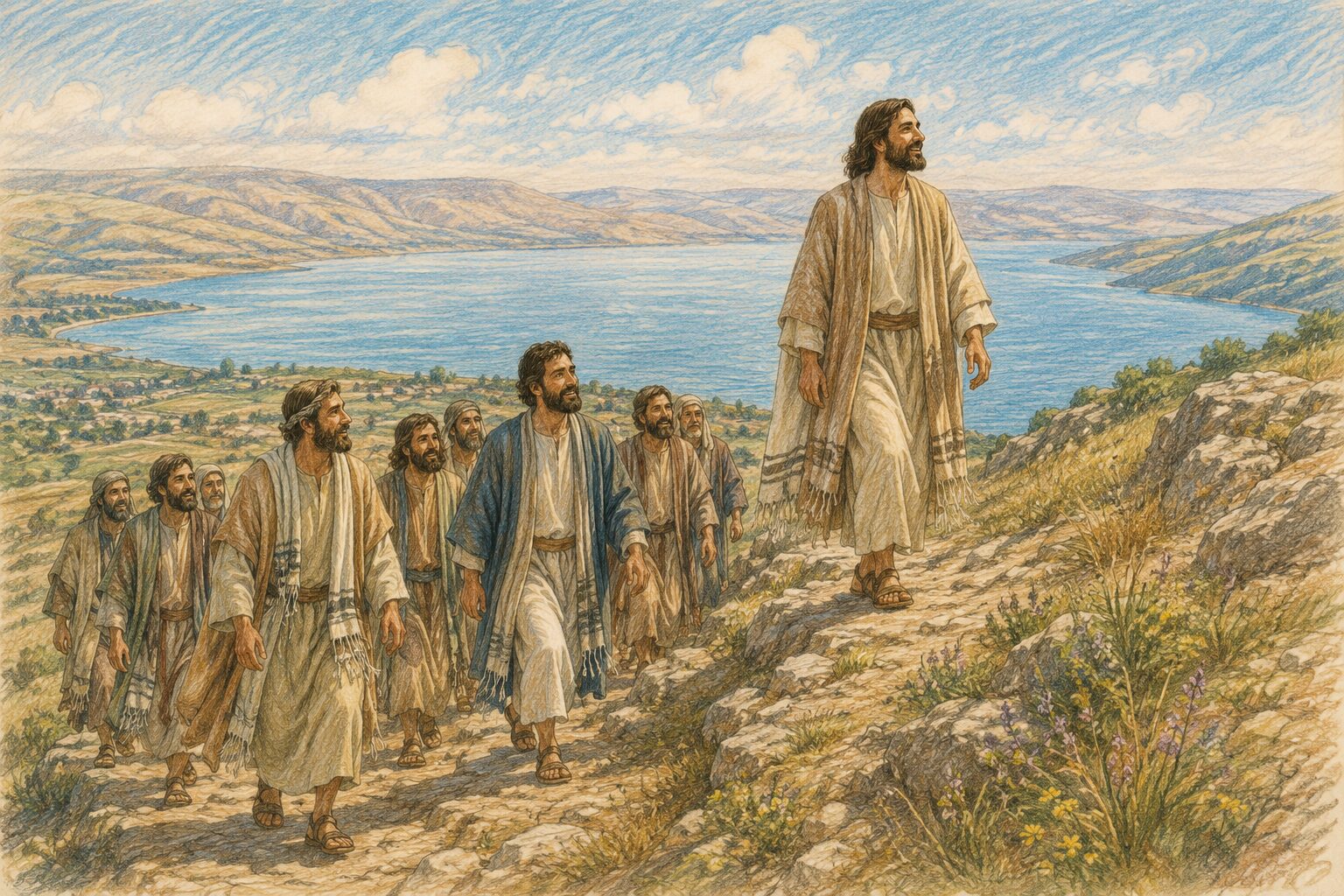
The Sermon on the Mount is one of Jesus’ most beloved teachings. It contains the Beatitudes, the Lord’s Prayer, the command to love our enemies, and many of the passages Christians know best. Yet these teachings are often read outside of the context of Jesus’ mission.
In this article and the articles that follow we will walk through the context and the Sermon on the Mount to see it as more than a collection of moral lessons, but the Messiah’s instruction for life in God’s restoring kingdom.
Before Jesus ever sits down to teach, Matthew spends four chapters introducing Him and explaining why He has come. By the time Jesus climbs the mountain in Matthew 5, Matthew has already shown that Jesus is Israel’s promised Messiah, the King through whom God is beginning to fulfill His promises to restore His people.
Matthew 1–4: Preparing Us for the Sermon
Matthew opens his Gospel with a striking statement:
“The record of the genealogy of Jesus the Messiah, the son of David, the son of Abraham” (Matt. 1:1, NASB).
These two titles (son of David & son of Abraham) tell us almost everything we need to know about Jesus’ mission.
As the Son of Abraham, Jesus is connected to God’s promise to bless all the nations through Abraham’s family (Gen. 12:1–3; 22:17–18). As the Son of David, He is the promised King who would reign forever over God’s people (2 Sam. 7:12–16; Isa. 11:1–10).
Matthew’s genealogy also reminds readers of Israel’s exile (Matt. 1:17). Although the Jewish people had returned to the land centuries earlier, the prophets spoke of a greater restoration still to come—a day when God would forgive His people, renew their hearts, gather the scattered, and establish His kingdom (Isa. 40:1–11; Jer. 31:31–34; Ezek. 36:24–28; 37:21–28). First-century Jews were still looking for the Messiah who would bring those promises to fulfillment.1
Matthew then begins showing that Jesus is that Messiah by describing how his birth fulfills the promises of Scripture (Matt. 1:22–23; 2:5–6, 15, 17–18, 23). He is called “Immanuel,” meaning “God with us” (Matt. 1:23). Even His name, Jesus (Yeshua), points to His mission: “He will save His people from their sins” (Matt. 1:21).
The King Arrives
When John the Baptist appears, his message is simple:
“Repent, for the kingdom of heaven is at hand” (Matt. 3:2).
John was announcing that God’s long-awaited kingdom was drawing near. He even quotes Isaiah 40, a chapter that begins with God’s promise to comfort His people after exile and prepare the way for the Lord Himself (Matt. 3:3; Isa. 40:3–5).
Jesus joins this movement by coming to John for baptism (Matt. 3:13–17). As He comes out of the water, the Father declares,
“This is My beloved Son, in whom I am well pleased” (Matt. 3:17).
These words echo both Psalm 2, where God appoints His anointed King, and Isaiah 42, where God’s Servant is empowered by the Spirit to bring justice and hope to Israel and the nations (Ps. 2:7; Isa. 42:1–4). Matthew is showing that Jesus is both the promised King and the Servant through whom God’s restoration will come.2
Immediately afterward, Jesus enters the wilderness for forty days (Matt. 4:1–11). Just as Israel spent forty years in the wilderness, Jesus spends forty days being tested. Yet where Israel repeatedly failed, Jesus remains faithful, answering every temptation with God’s Word from Deuteronomy (Deut. 6:13, 16; 8:3). Jesus succeeds where Israel failed as the faithful Son of God.
When His testing is complete, Jesus begins preaching the exact same message John proclaimed:
“Repent, for the kingdom of heaven is at hand” (Matt. 4:17).
He calls disciples (Matt. 4:18–22), teaches in the synagogues, proclaims the good news of the kingdom, and heals the sick (Matt. 4:23–25). These miracles are signs that God’s restoring reign has begun, fulfilling the prophets’ vision of a day when the blind would see, the lame would walk, and good news would be proclaimed to the afflicted (Isa. 35:5–6; 61:1–3).
By the end of chapter four, Matthew has introduced Him and explained why He has come:
Jesus is Israel’s Messiah, The kingdom has arrived, God’s work of restoration has begun.
Then Jesus Climbs the Mountain
Only after telling this story does Matthew write,
“When Jesus saw the crowds, He went up on the mountain…and He opened His mouth and began to teach them” (Matt. 5:1–2).
Throughout Israel’s history, mountains were places where God revealed His will. Most notably, Moses received the Torah on Mount Sinai (Exod. 19–24).
Jesus is not simply repeating Moses, nor is He replacing him. He is the promised Messiah who teaches God’s people with divine authority. At the end of the sermon, the crowds are amazed because “He was teaching them as one having authority, and not as their scribes” (Matt. 7:28–29).
Everything that follows—the Beatitudes, the call to be salt and light, Jesus’ teaching about the Law and the Prophets, and the well-known statements beginning with “You have heard…but I say to you”—must be read within this setting.
The Sermon on the Mount is the Messiah’s announcement of what life looks like under God’s kingdom as His promises to restore Israel begin to unfold.
Reading the Sermon as Matthew Intended
Matthew does not present the Sermon on the Mount as a disconnected collection of ethical sayings. He carefully prepares his readers through the first four chapters so they understand who Jesus is before they hear what He says.
Jesus is the Son of Abraham, the Son of David, the faithful Son who succeeds where Israel failed. He is the Spirit-anointed Messiah who proclaims God’s kingdom and begins fulfilling the prophets’ hope for restoration.
As we continue through the Sermon on the Mount, keeping this larger story in view will help us hear Jesus’ words the way Matthew intended. The Beatitudes, Jesus’ teaching about the Torah, and His call to a deeper righteousness are not isolated commands. They are the instruction of Israel’s Messiah for the people of God’s kingdom.
In the next article, we’ll begin with the opening words of the sermon itself—the Beatitudes—and discover how they describe the character of those who belong to God’s restoring kingdom.
- Paul T. Sloan, Jesus and the Law of Moses (Grand Rapids: Baker Academic, 2025), 73-76, “The Law on the Mount.” Sloan argues that Matthew frames Jesus’ ministry within Israel’s ongoing expectation of covenant restoration before introducing the Sermon on the Mount. ↩︎
- See also R. T. France, The Gospel of Matthew (Grand Rapids: Eerdmans, 2007), 103–121; Dale C. Allison Jr., The New Moses: A Matthean Typology (Minneapolis: Fortress Press, 1993), 137–172; E. P. Sanders, Jesus and Judaism (Philadelphia: Fortress Press, 1985), 61–119. ↩︎
Leave a Reply
You must be logged in to post a comment.