
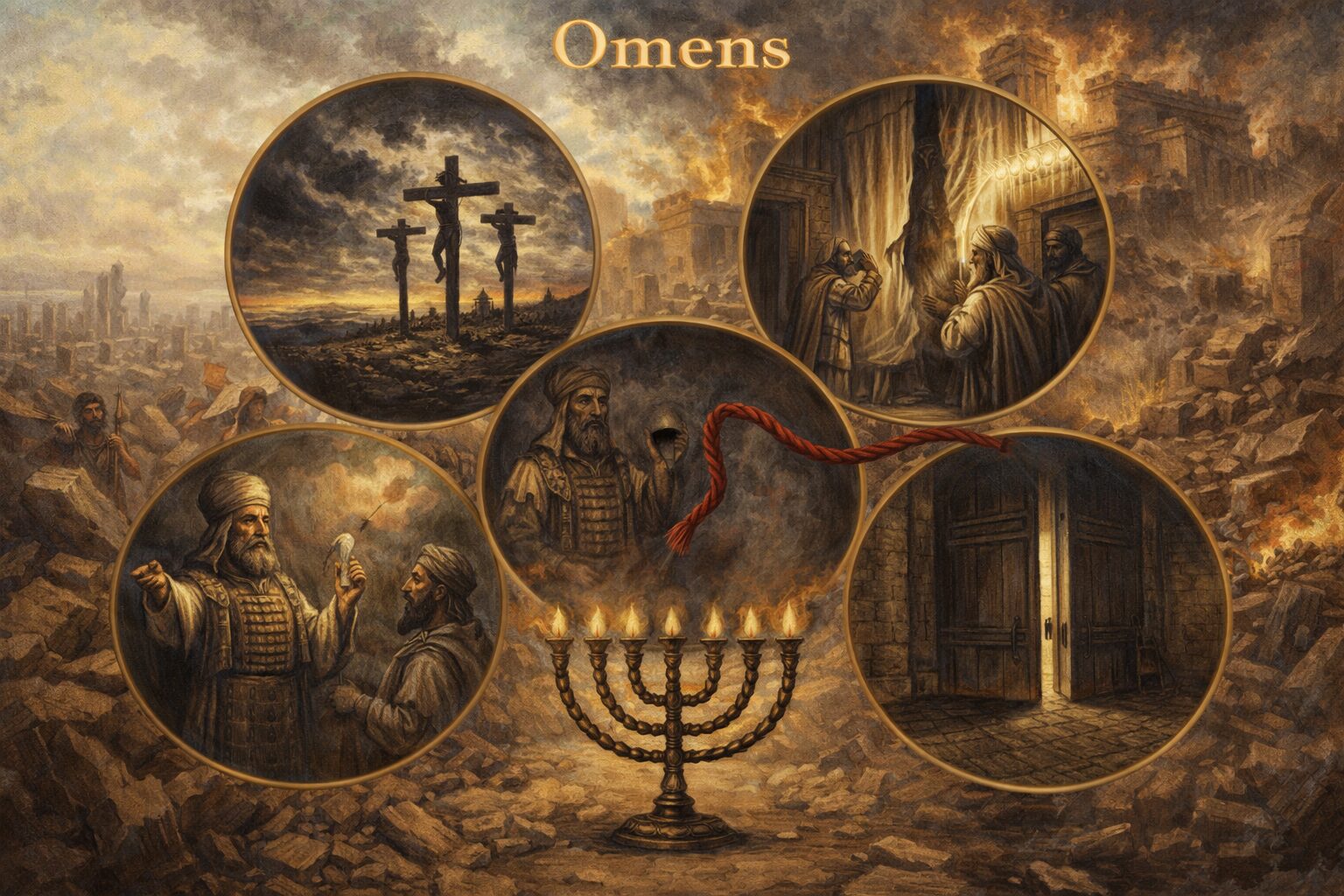
When Jesus declared, “There will not be left here one stone upon another that will not be thrown down” (Matthew 24:2), He was not speaking into a quiet or uneventful time, but into the active Second Temple Period. Both the Gospels and Jewish sources remember the years surrounding His death as the beginning of a sustained pattern of signs connected to the Temple itself—signs that continued for forty years until its destruction in 70 AD.
The Gospels record immediate phenomena at His crucifixion: darkness at midday (Matthew 27:45), an earthquake (Matthew 27:51), and most significantly, “the curtain of the temple was torn in two, from top to bottom” (Matthew 27:51). This event alone signals a disruption within the Temple at the exact moment of His death.
Jewish tradition then records that a series of ongoing Temple omens began at that same time:
“For the forty years before the destruction of the Temple… the lot did not come up in the right hand; the scarlet thread did not turn white; the western lamp did not stay lit; and the doors of the Temple would open by themselves.” (b. Yoma 39b)
This record that states these signs began “forty years before the destruction of the Temple” (b. Yoma 39b) in 70 AD, this places the beginning of these omens around 30 AD—the same general period in which Jesus was crucified.
This establishes a clear historical claim: the pattern of Temple disruption begins around 30 AD and continues until 70 AD.
The Specific Omens and Their Meaning
Each omen corresponds directly to the Temple service described in the Torah, and each includes a preserved statement in Jewish tradition.
The Yom Kippur Lot Failing (Leviticus 16)
“The lot [for the LORD] did not come up in the right hand.” (b. Yoma 39b)
The high priest cast lots to determine the sacrificial roles. The consistent failure of the “favorable” outcome was understood as a negative sign regarding the atonement ritual itself.
The Scarlet Thread Not Turning White (Isaiah 1:18)
“The strip of red cloth did not turn white.” (b. Yoma 39b)
The thread symbolized the removal of sin—“though your sins are like scarlet, they shall be as white as snow.” Its failure to change signaled that the expected sign of forgiveness was absent.
The Western Lamp Going Out (Exodus 27:20–21)
“The western light did not stay lit.” (b. Yoma 39b)
This lamp, associated with the continual presence of God, repeatedly extinguished, interrupting what was meant to be an ongoing testimony.
The Temple Doors Opening by Themselves
“The doors of the Temple would open by themselves.” (b. Yoma 39b)
Rabbinic sources later interpret this as a warning of destruction, as though the sanctuary itself was being opened to judgment.
Corroborating First-Century Testimony
The historian Josephus records similar signs in the same general period:
- “A light shone around the altar and the sanctuary” (Jewish War 6.289)
- “The eastern gate… opened of its own accord” (War 6.293)
- A voice in the Temple declaring, “Let us depart from here” (War 6.299)
These accounts align closely with the rabbinic memory of Temple disturbances.
Jesus’s Warnings in This Context
Jesus’s teachings directly address the fate of the Temple during this same period:
- “Your house is left to you desolate” (Matthew 23:38)
- “There will not be left here one stone upon another” (Matthew 24:2)
- Jerusalem’s destruction would come “because you did not know the time of your visitation” (Luke 19:44)
These statements were spoken during the very generation in which these signs were said to begin.
A First-Century Framework
Second Temple Jewish literature reflects a worldview in which earthly events mirrored heavenly realities. Apocalyptic texts like 1 Enoch describe divine judgment, heavenly visions, and the coming Son of Man . Within this framework, disruptions in the Temple would naturally be interpreted as signs of larger spiritual realities.
At the same time, the Temple service continued—sacrifices, priesthood, and daily worship remained central to Jewish life. This makes the recorded omens even more significant: they occurred within a fully functioning system.
Conclusion
Taken together, the sources present a consistent picture:
the Gospels record immediate signs at Jesus’s death, rabbinic tradition records a forty-year pattern of Temple omens beginning at that same time, and Josephus preserves parallel reports of disturbances leading up to 70 AD.
This convergence strengthens the historical case that the destruction of the Temple did not come without warning. According to both early Jewish memory and the testimony of the New Testament, the signs began in the very days when Jesus spoke of its coming fall.
Bibliography:
Babylonian Talmud, Yoma 39b.
Josephus, Jewish War 6.289–300.
James C. VanderKam, An Introduction to Early Judaism (Grand Rapids, MI: Eerdmans, 2001), 1–15.
D. Thomas Lancaster, Acts of the Apostles Commentary (1–46) (Marshfield, MO: First Fruits of Zion, n.d.), Acts 1.
Leave a Reply
You must be logged in to post a comment.