
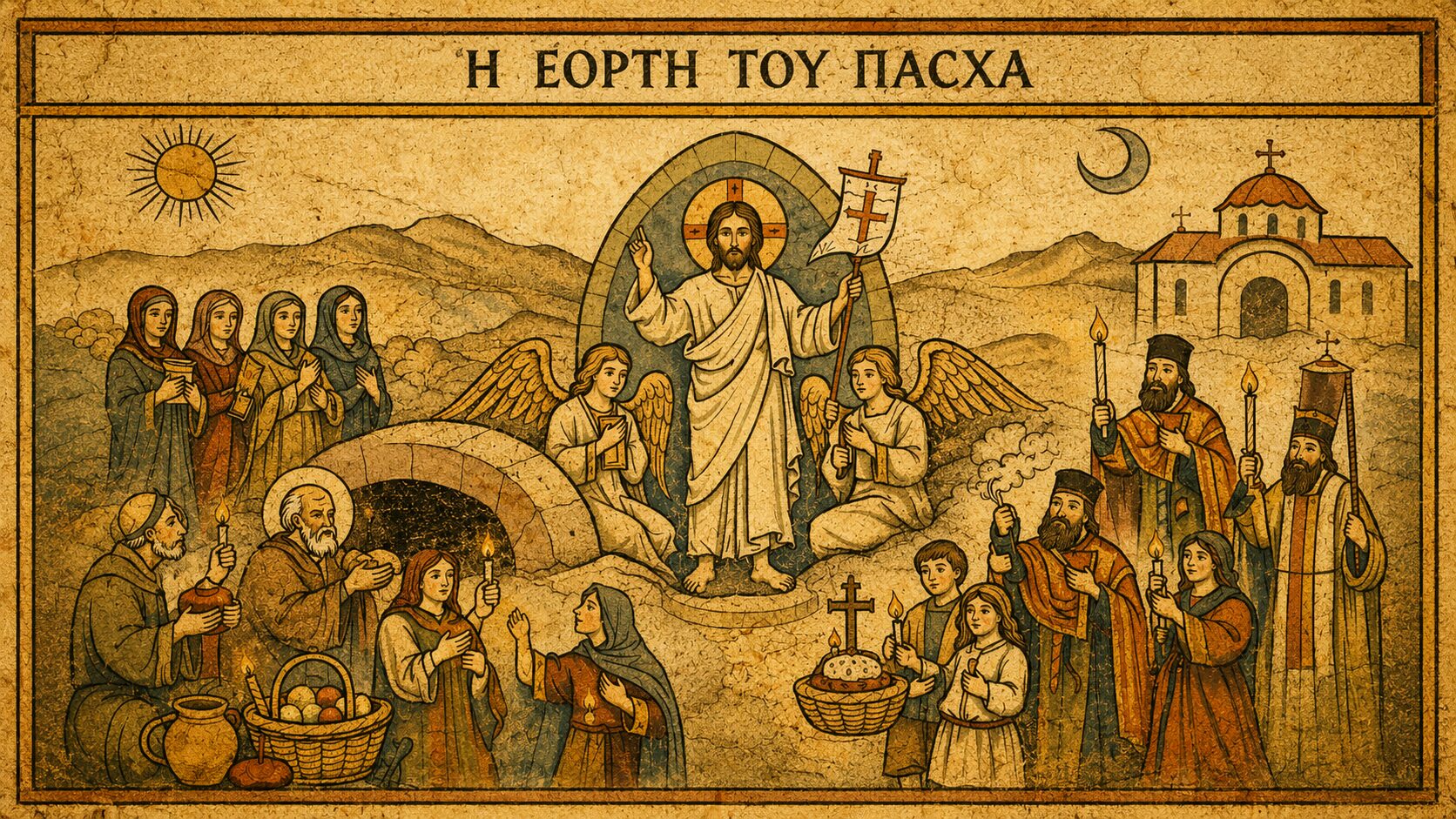
Pascha, Easter, and the Slow Separation of the Church from Israel
Many Christians assume the split between the Church and the Jewish people happened early—almost immediately after Jesus. But history tells a much slower, more complicated story. In this article we will follow the development of Pascha—the early Christian observance of Jesus’ death and resurrection that culminated in the celebration of Easter— and through this we will discover that the separation between the Church and Israel unfolded gradually over centuries.
Acts 15: A United People, Not a Replaced One
The story of the relationship between the Jewish Jesus believing community and the Gentile believing community begins not with separation, but with unity. At the Jerusalem Council in Acts 15, the apostles confront a critical question: must Gentiles become Jews to follow Messiah?
Peter declares:
“God, who knows the heart, bore witness to them, by giving them the Holy Spirit just as he did to us, and he made no distinction between us and them” (Acts 15:8–9).
James then concludes:
“Therefore my judgment is that we should not trouble those of the Gentiles who turn to God” (Acts 15:19).
Gentiles are not required to be circumcised or take on full Torah obligation. But they are not cut off from Israel’s life either. James immediately adds:
“For from ancient generations Moses has had in every city those who proclaim him, for he is read every Sabbath in the synagogues” (Acts 15:21).
Gentile believers remain connected to a Jewish world—its Scriptures, its rhythms, and the focus of this article in particular… its calendar. This is the foundation for everything that follows.
What Was Pascha? A Passover-Shaped Celebration
The earliest Christians did not celebrate “Easter.” They celebrated Pascha—the Greek word for Passover. One of the earliest voices we have describing this celebration is Melito of Sardis, he describes Pascha this way:
“This is the Pascha of our salvation…
this is the one who was sacrificed in the lamb…
this is the one who was buried in the earth,
who was raised from the dead,
and who raised mankind from the grave below.”
— On Pascha
For Melito and for the early church “Easter was called Pascha… derived from the Hebrew word Pesach… because the early Gentile Christian holiday centered on the remembrance that Jesus is the Passover lamb of God.”1
The New Testament confirms this framework:
“Christ, our Passover lamb, has been sacrificed. Therefore let us keep the feast” (1 Corinthians 5:7–8).
But Pascha was not simply a Jewish seder repeated by Gentiles.
A key early source, the Didascalia Apostolorum (3rd century), describes how Gentile Christians observed it:
“You shall fast on the days of the Pascha, beginning from the tenth… and on the Friday and the Sabbath you shall fast wholly, and taste nothing. And you shall gather together, watching and keeping vigil all the night with prayers and intercessions and readings of the prophets, and the Gospel and the Psalms… and then break your fast.”
This shows us something important. Pascha was already distinct from Jewish practice—focused on fasting, vigil, and Eucharist—but still tied directly to Passover timing and meaning within the early church.
A Church Dependent on the Jewish Calendar
In many regions, Christians celebrated Pascha on Nisan 14, the same day as Jewish Passover. This required dependence on the Jewish community.
Epiphanius preserves an earlier instruction:
“You shall not calculate, but celebrate the feast with your brethren from the Circumcision…
keep it with them…
for this was their chief concern—that there be unity… one feast celebrated.”
— Epiphanius, Panarion 70.10
Eusebius also describes this tying of Pascha directly to Passover in the early believing community:
“The churches of all Asia… thought that they ought to observe the fourteenth day of the moon, on which the Jews had been commanded to sacrifice the lamb…
for they maintained that they ought to keep the feast on that day, whatever day of the week it might be.”
— Ecclesiastical History 5.23
This is a remarkable window into early Christian identity. The Church did not yet see itself as independent from Israel—it saw itself as linked to Israel’s sacred time.
Polycarp and Rome: Disagreement Without Division
By the mid-2nd century, we encounter Polycarp, a disciple of the apostle John. Polycarp observed Pascha on Nisan 14, following apostolic tradition. When he visited Rome, he disagreed with Bishop Anicetus, who followed a Sunday observance that was becoming popular throughout the Roman world.
Irenaeus, preserved by Eusebius, records:
“Neither could Anicetus persuade Polycarp not to observe it, inasmuch as he had always observed it with John the disciple of our Lord… nor did Polycarp persuade Anicetus… but they immediately made peace, having no wish for strife between them on this matter.”
(Eusebius, Ecclesiastical History 5.24.16)
At this stage, the Church still held unity despite disagreement on the day of observance.
The Quartodeciman Controversy: When Unity Began to Crack
But this disagreement eventually developed into what is known as the Quartodeciman controversy (“fourteenth” observance). Churches in Asia Minor continued observing Pascha on Nisan 14, while Rome insisted on shifting away from the use of the Jewish calendar and observing the day on Sunday. This followed increased anti-jewish rhetoric by many early church leaders.
Polycrates of Ephesus defends the apostolic tradition, writing to Rome over the controversy:
“We observe the exact day; neither adding nor taking away.
For in Asia great luminaries have fallen asleep… Philip, one of the twelve apostles…
John, who leaned on the Lord’s breast… Polycarp in Smyrna…
All these observed the fourteenth day of the Passover according to the Gospel…And I also, Polycrates… am not afraid of threats…
for those greater than I have said, ‘We must obey God rather than men.’”
— Eusebius, Ecclesiastical History 5.24.2–7
Polycrates of Ephesus claims apostolic continuity in following the Jewish calendar in celebrating Pascha in unison with the festival of Passover. He is even claims that he is not afraid of the threats of Rome, and sees the observance on the day of Nisan 14 as a command from God.
Rome Responds: Excommunication
The tone now shifts dramatically. Victor, the bishop of Rome, attempts to enforce uniformity. When the Asian churches refuse to change the day they celebrate Pascha, he excommunicates them.
Eusebius records:
“Victor, who presided over the church at Rome, immediately attempted to cut off from the common unity the parishes of all Asia…
and he declared all the brethren there wholly excommunicated.”
— Eusebius, Ecclesiastical History 5.24.9
This is where the nature of the Church begins to change. What had once been a diverse but unified body—still connected to its Jewish roots—now begins to define itself by separation, drawing lines where there had previously been space for shared life. And the slow unraveling of a shared life between Jewish and Gentile believers becomes more visible.
The Council of Arles (314 CE): Standardizing Unity
Despite the explicit ruling of Rome, more than a century later we still find communities of believers that continue to celebrate Pascha on Nisan 14 according to apostolic tradition. This topic was significant enough that it was addressed In the the first major representative meeting of Christian bishops in the Western Roman Empire
The Council of Arles declares:
“That the Pascha be observed on one day and at one time throughout the whole world…
and that you [bishop of Rome] should send letters to all, according to custom.”
— Council of Arles, Canon 1 (314 CE)
The need for a council to address this issue more than a century later makes one thing clear: the separation was not complete. The persistence of Nisan 14 observance shows that the older, Passover-shaped understanding of Pascha reminds us that the story of separation was still unfolding, not yet settled.
The Council of Nicaea (325 AD): A Decisive Break
At the 1st council of Nicaea, the anti-jewish rhetoric peaks and the topic is brought up again. The ruling of the council is even more firm against the following of the Jewish calendar for Pascha.
Constantine’s letter to the churches after the Council of Nicaea (preserved in Eusebius), details this clearly:
“When the question relative to the most holy day of Easter arose, it was universally thought that it would be convenient that all should keep the feast on one day…
It was declared to be particularly unworthy for this, the holiest of all festivals, to follow the custom of the Jews, who had soiled their hands with the most fearful of crimes, and whose minds were blinded.
In rejecting their custom, we may transmit to our descendants the legitimate mode of celebrating Easter, which we have observed from the time of our Saviour’s Passion to the present day.
We ought not, therefore, to have anything in common with the Jews, for the Saviour has shown us another way. Our worship follows a more legitimate and more convenient course…
For how can they be in the right, who, after the death of the Lord, have been led astray by mad error, and who are governed not by reason, but by unrestrained passion?
Therefore, let us have nothing in common with this most hostile people. We desire, dearest brethren, to separate ourselves from the detestable company of the Jews… and to avoid all participation in their perjured conduct.”
— Life of Constantine 3.18–19
Here the issue is no longer simply about when to celebrate Pascha, but about how the Church understands itself. The rejection of the Jewish calendar becomes a statement of identity—defining the Church not in continuity with Israel, but in deliberate distance from it. Pascha is a focus, but also anything “having to do with the Jews”. The matter is no longer about unity, It is about separation from the Jewish people.
The Nicene Creed: A Tension in History
The 1st council of Nicaea marks a decisive break in the apostolic tradition in the celebration of Pascha (by then known as Easter), and a time when Anti-Jewish rhetoric that had been building for centuries had finally peaked in the the church. But the council also preserved very valuable theology and tradition on Christology and the deity of Jesus. the Church confesses:
“We believe in one Lord Jesus Christ… God of God, Light of Light, very God of very God… of one substance with the Father.”
The Church affirms the identity of Israel’s Messiah—while simultaneously distancing itself from Israel’s people. A pattern that would continue throughout church history. So while there were many great things that came from the council of Nicaea, we also acknowledge the culmination of an unfortunate break between the church and the people of Israel and their cultural context.
The Second Council of Nicaea (787 CE): The Long Trajectory
By the time of the Second Council of Nicaea in 787, the question of the Church’s relationship to the Jewish people is no longer even debated. They took the prior decisions of the church and ruled that if anyone rejects the teachings of that tradition they should be shunned/exommunicated:
“We follow… the ecclesiastical traditions handed down to us, whether written or unwritten…
for if anyone rejects any ecclesiastical tradition… let him be anathema.”
— Second Council of Nicaea, Definition of Faith (787 CE)
The council does not argue for separation—it assumes that it already exists, and ensured that it does through excommunication. Authority now rests entirely in ecclesiastical tradition, with no reference to the Jewish calendar, the apostles’ Passover practice, or the earlier dependence on the Jewish community for sacred time. What had once been a contested relationship has now disappeared from the conversation entirely.
Why does this matter?
This matters because it challenges the common assumption that Christianity quickly and cleanly separated from Judaism in the first century. The historical evidence shows a much slower process, where the early Jesus movement remained deeply connected to Israel’s life, calendar, and Scriptures for generations. That means many of the tensions we read in the New Testament are not between two different religions, but internal debates within the people of God. Recognizing this helps us avoid reading later divisions back into the apostolic age and invites us to interpret these texts within their original Jewish context.
For Gentile believers, this reshapes how we understand our place in the story. Rather than seeing ourselves as replacing Israel, we begin to see that we have been brought into an already existing covenantal narrative. It calls us to humility, reminding us that the roots of our faith are not our own, and to greater care in how we read Scripture and understand God’s ongoing faithfulness to His people.
If the earliest believers remained deeply connected to Israel’s story, how might that change the way we understand our own place in that story today?
If this topic is interesting to you, please read my longer and more in-depth academic article I wrote on this topic.
- David Rudolph, “The Council of Nicaea, the Dating of Easter, and Its Implications Concerning the Church’s Relationship to the Jewish People” (paper presented at the Second Annual Alleluia Forum on Unity and Renewal, The King’s University, Southlake, TX, June 26–28, 2025), ↩︎
Bibliography (Primary Sources):
Eusebius of Caesarea. The Ecclesiastical History. Translated by Kirsopp Lake. Loeb Classical Library. Cambridge, MA: Harvard University Press, 1926.
Eusebius of Caesarea. Life of Constantine. Translated by Averil Cameron and Stuart G. Hall. Oxford: Clarendon Press, 1999.
Melito of Sardis. On Pascha. Translated by Alistair Stewart-Sykes. Crestwood, NY: St. Vladimir’s Seminary Press, 2001.
Didascalia Apostolorum. Translated by Alistair Stewart-Sykes. Turnhout: Brepols, 2009.
Epiphanius of Salamis. The Panarion of Epiphanius of Salamis. Translated by Philip R. Amidon. Oxford: Oxford University Press, 1990.
Council of Arles. “Canons of the Council of Arles (314).” In Nicene and Post-Nicene Fathers, Second Series, Vol. 14. Edited by Philip Schaff and Henry Wace. Peabody, MA: Hendrickson, 1994.
Council of Nicaea (325). “Synodal Letter of the Council of Nicaea.” In Nicene and Post-Nicene Fathers, Second Series, Vol. 14. Edited by Philip Schaff and Henry Wace. Peabody, MA: Hendrickson, 1994.
Second Council of Nicaea (787). “Definition of Faith.” In Nicene and Post-Nicene Fathers, Second Series, Vol. 14. Edited by Philip Schaff and Henry Wace. Peabody, MA: Hendrickson, 1994.
Bibliography (Modern Sources):
Rudolph, David. “The Council of Nicaea, the Dating of Easter, and Its Implications Concerning the Church’s Relationship to the Jewish People.” Paper presented at the Second Annual Alleluia Forum on Unity and Renewal, The King’s University, Southlake, TX, June 26–28, 2025.
Schremer, Adiel. Brothers Estranged: Heresy, Christianity, and Jewish Identity in Late Antiquity. Oxford: Oxford University Press, 2010.
Dunn, James D. G. The Partings of the Ways between Christianity and Judaism and Their Significance for the Character of Christianity. 2nd ed. London: SCM Press, 2006.
Leave a Reply
You must be logged in to post a comment.