
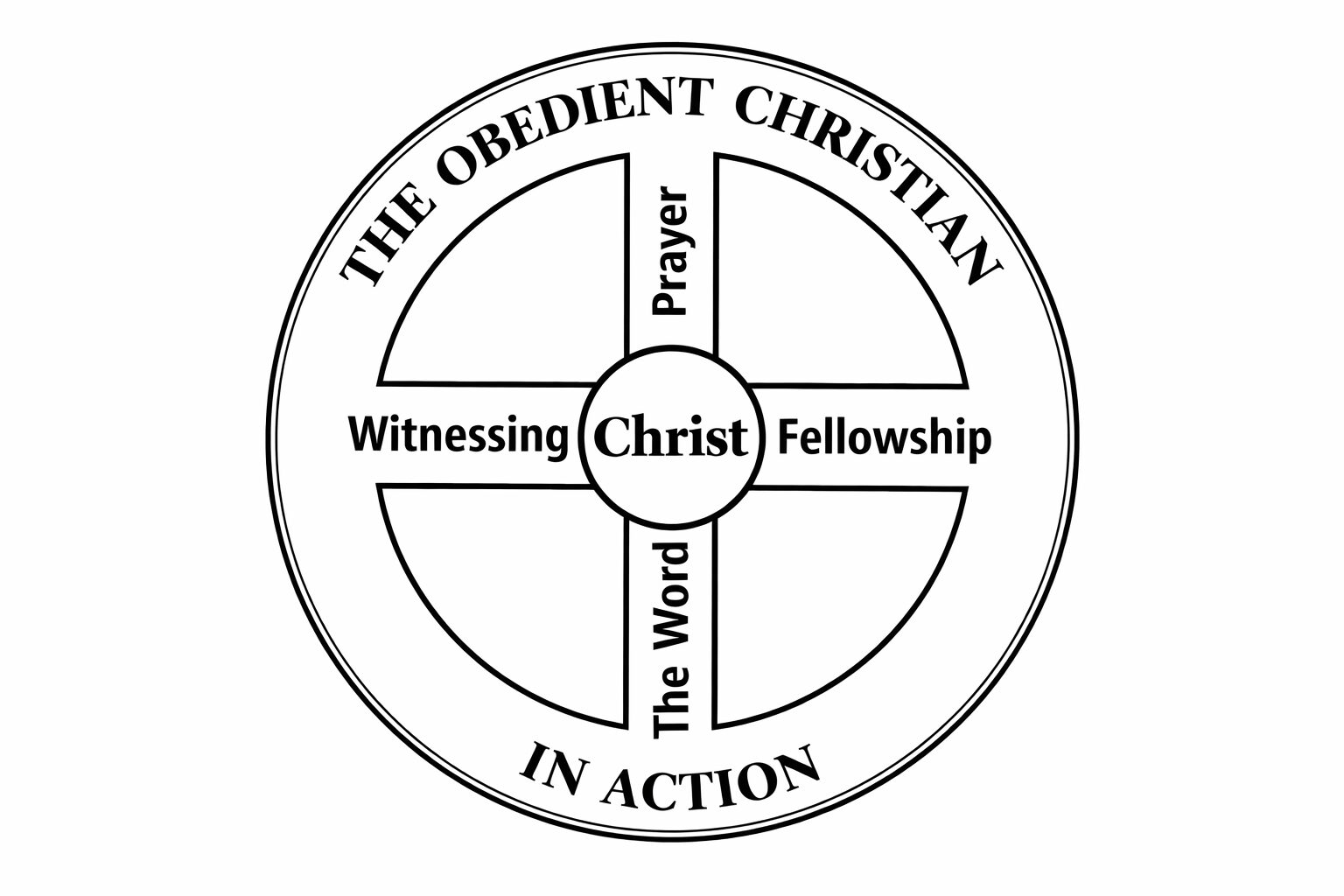
For more than a decade, one of the discipleship tools I keep returning to is the Wheel Illustration from The Navigators. I have drawn it on napkins, notebooks, and whiteboards, and I still find myself revisiting it for my own self-evaluation. It is simple, almost deceptively so, yet it consistently invites honest reflection. While it does not capture every complexity of discipleship, it gives just enough structure to help me ask whether my life with God is actually moving forward.
At the center of the wheel is Christ. That placement matters. Discipleship does not begin with habits or disciplines, but with allegiance. Paul says, “It is no longer I who live, but Messiah lives in me” (Galatians 2:20). If Christ is not the hub, the rest of the wheel may look active, but it will not be aligned. Jesus Himself frames discipleship this way: “Abide in Me, and I in you… apart from Me you can do nothing” (John 15:4–5). Everything else flows outward from a living relationship with Him.
From that center extend four spokes that bring balance and stability. Two of them form the vertical relationship with God: the Word and prayer. Scripture shapes how we see God, ourselves, and the world. “Your word is a lamp to my feet and a light to my path” (Psalm 119:105). Over the years, I have learned that neglecting the Word does not usually lead to immediate failure, but to slow spiritual drift. Jesus says plainly, “If you abide in My word, you are truly My disciples” (John 8:31).
Prayer completes that vertical axis. It is not merely asking God for things, but learning to live in awareness of His presence. Jesus regularly withdrew to pray (Luke 5:16), modeling a life oriented toward the Father. When prayer weakens, discernment dulls. Scripture’s call to “pray without ceasing” (1 Thessalonians 5:17) is not about constant speech, but continual dependence.
The other two spokes form the horizontal axis: fellowship and witnessing. Fellowship reminds us that discipleship is communal. The early believers “devoted themselves to the apostles’ teaching and the fellowship” (Acts 2:42). Community exposes blind spots, encourages faithfulness, and guards against isolation. When fellowship weakens, discipleship often becomes abstract and self-directed.
Witnessing keeps discipleship outward-facing. Jesus tells His followers, “You will be My witnesses” (Acts 1:8). A disciple’s life is not meant to terminate on itself. When this spoke weakens, faith easily turns inward, losing its missional heartbeat.
Holding all of these spokes together is the outer rim of the wheel: obedience. This is where the illustration presses hardest. A wheel with strong spokes but no rim cannot roll. Jesus connects love and obedience directly: “If you love Me, you will keep My commandments” (John 14:15). Obedience is not opposed to grace; it is the lived response to it. Moses framed it as a choice of life: “I have set before you life and death… therefore choose life” (Deuteronomy 30:19). Jesus echoes this when He says the wise person is the one who hears His words and does them (Matthew 7:24).
And while this self reflection is not an all encompassing evaluation of your relationship with God, It can help us reflect at a high level on some of the general out workings of being a disciple of Christ. One reason this illustration has stayed with me is that it invites honesty. Every season reveals different strengths and weaknesses. Sometimes Scripture is strong and prayer is thin. Other times community flourishes while obedience feels costly. The wheel gives language for those realities and invites intentional growth rather than guilt.
So I’ll end with the same questions I return to again and again: What does your discipleship wheel look like? Where are your strengths, and where are your weaknesses? And what are you going to do about it?
Explore the Wheel Illustration further and other discipleship resources at https://www.navigators.org/
Leave a Reply
You must be logged in to post a comment.