
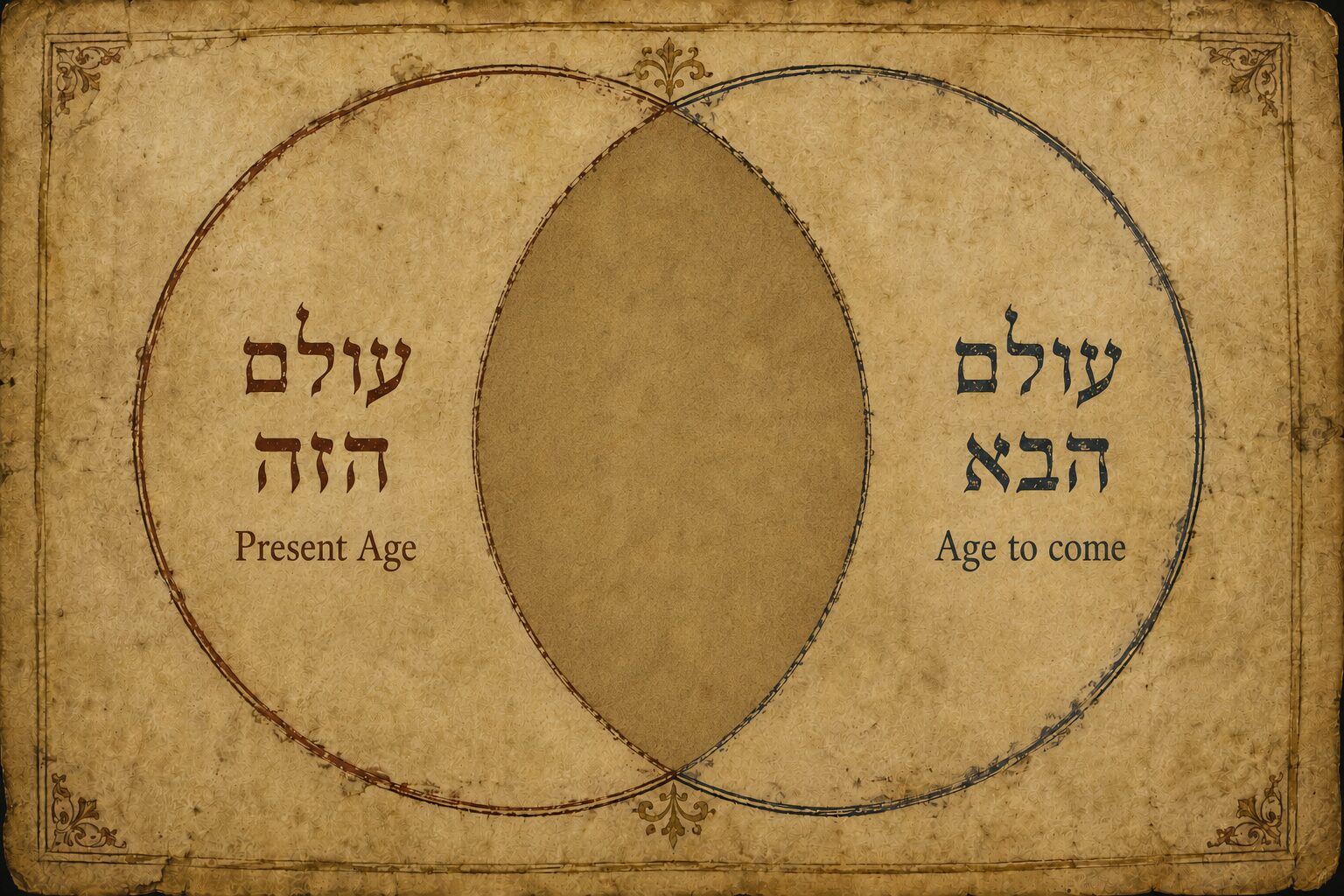
Most Christians are familiar with the idea of “the end times” and are usually familiar with a modern concept of being removed from the earth to a place called “heaven” when you die. But few realize that Jesus and the apostles understood history and the end times through a very Jewish framework called the “two ages.” In Hebrew, these are called Olam HaZeh (“this present age”) and Olam Haba (“the age to come”).
Ages in the First Century
Jesus speaks about “this age and the age to come” in Matthew 12:32. In Luke 20:34–36, He contrasts people who belong to “this age” with those worthy to attain “that age and the resurrection from the dead.” Paul says believers are those “upon whom the end of the ages has come” (1 Corinthians 10:11).
So what do these two ages mean?
Olam HaZeh (ולם הזה) refers to the present world order. It is the age marked by sin, suffering, injustice, sickness, and death. It is the world as we experience it east of Eden. Paul says creation itself has been “subjected to futility” and is “groaning” as it waits for redemption (Romans 8:20–23). This present age is temporary and broken.
Jewish teachers in the days of Yeshua contrasted this with Olam Haba (עולם הבא), the age to come. This future age would be marked by resurrection, peace, justice, and the reign of Messiah. Isaiah described it as a time when nations would no longer learn war (Isaiah 2:2–4), creation itself would be healed (Isaiah 11:6–9), and death would be swallowed up forever (Isaiah 25:8).
One famous saying from the Mishnah states, “This world is like a vestibule before the world to come; prepare yourself in the vestibule so that you may enter the banquet hall” (Pirkei Avot 4:16). Another Jewish text says, “All Israel have a share in the world to come” (m. Sanhedrin 10:1). This expectation of a coming redeemed age shaped the worldview of many Jewish people in second temple period (the first century & prior).
This also explains why the apostles spoke so much about resurrection. For them, salvation was not escaping earth to live as disembodied spirits forever. The hope was resurrection and the renewal of creation itself. Hebrews speaks of “the world to come” (Hebrews 2:5), while Paul says creation itself will one day be set free from corruption (Romans 8:21).
Living Between 2 Ages
But here is where the New Testament introduces something surprising. According to Jesus and the apostles, the age to come has already begun, yet not in it’s fullness. The statements balance a present reality and a future hope.
Jesus often spoke about the Kingdom in both present and future terms. In John 4:23 He says, “the hour is coming, and is now here,” and in John 5:25 He again declares that a future resurrection reality is already beginning in the present. This is the tension of the overlapping ages: the promises of the age to come have begun through Christ (Messiah), even though their fullness still awaits the future.
When Jesus rose from the dead, the powers of the future age broke into the present one. His resurrection was the beginning of the resurrection promised for the end of the age. That is why Paul calls Him the “firstfruits” (1 Corinthians 15:20). The outpouring of the Spirit at Pentecost was further evidence that the Kingdom of God had already begun to invade the present world. Hebrews even says believers have “tasted the powers of the age to come” (Hebrews 6:5).
Many Christians already know this concept through the phrase “already and not yet” theology. Scholars such as Geerhardus Vos1 and George Eldon Ladd2 helped popularize this understanding in modern Christian theology, emphasizing that the Kingdom of God is both present now and awaiting future fulfillment. What many believers do not realize is that this framework is deeply rooted in the Jewish worldview of Jesus and the apostles: Olam HaZeh and Olam Haba.
Yet the age to come is not fully realized. We still experience the pain and brokenness of this present age even while experiencing the life and power of the coming age through Messiah and the Spirit. Death still exists, but resurrection has begun. Evil still operates, but Messiah has already been enthroned at the right hand of God (Psalm 110:1; Acts 2:33–36). This is why the New Testament speaks both of a present Kingdom and a future Kingdom. The ages are overlapping.
This framework changes how we read the Bible. The gospel is “not to snatch people away from earth to heaven, but to colonize earth with the life of heaven.”3 (N.T. Wright, Surprised by Hope). It is about the coming Kingdom of God, the resurrection of the dead, and the restoration of creation under the reign of Messiah.
Discipleship in Light of the Age to Come
The apostles believed believers should live now according to the values of the coming age. Paul says the grace of God teaches us “to renounce ungodliness and worldly passions” while we wait for Messiah’s appearing (Titus 2:11–13). We are meant to live as citizens of the coming kingdom even while still living in the present age.
That means disciples of Yeshua become previews of the world to come. We practice forgiveness in a world of hatred, generosity in a world of greed, and hope in a world ruled by death.
So are we in Olam Haba (The age to come) right now? In one sense, yes. The Kingdom has already been inaugurated through Jesus’s resurrection and the giving of the Spirit.
But in another sense, no. The fullness of the age to come still awaits Messiah’s return, the resurrection of the dead, and the renewal of all things.
Yeshua taught His disciples to live in light of the coming Kingdom. He taught us to pray, “Your kingdom come, your will be done, on earth as it is in heaven” (Matthew 6:10). Paul likewise says that “the night is far gone; the day is at hand” and therefore believers should “cast off the works of darkness and put on the armor of light” (Romans 13:12).
The hope of the coming age is not meant to make us disengage from the world, but to transform how we live within it. Because we believe resurrection is coming, we do not live as people enslaved to fear and death. Because we believe the Kingdom is coming, we pursue holiness, justice, mercy, forgiveness, and faithfulness now. Because we know Messiah will renew creation, we live as ambassadors of that coming renewal in the present age.
We are living between the ages, carrying the hope of the world to come into a world still waiting for redemption.
Bibliography:
Thiessen, Matthew. A Jewish Paul: The Messiah’s Herald to the Gentiles. Grand Rapids: Baker Academic, 2023. (particularly pg.75+)
- Geerhardus Vos, The Pauline Eschatology (Princeton, NJ: Princeton University Press, 1930) ↩︎
- George Eldon Ladd, The Gospel of the Kingdom: Scriptural Studies in the Kingdom of God (Grand Rapids: Eerdmans, 1959). ↩︎
- N.T. Wright, Surprised by Hope: Rethinking Heaven, the Resurrection, and the Mission of the Church (HarperOne, 2008). ↩︎
Leave a Reply
You must be logged in to post a comment.