
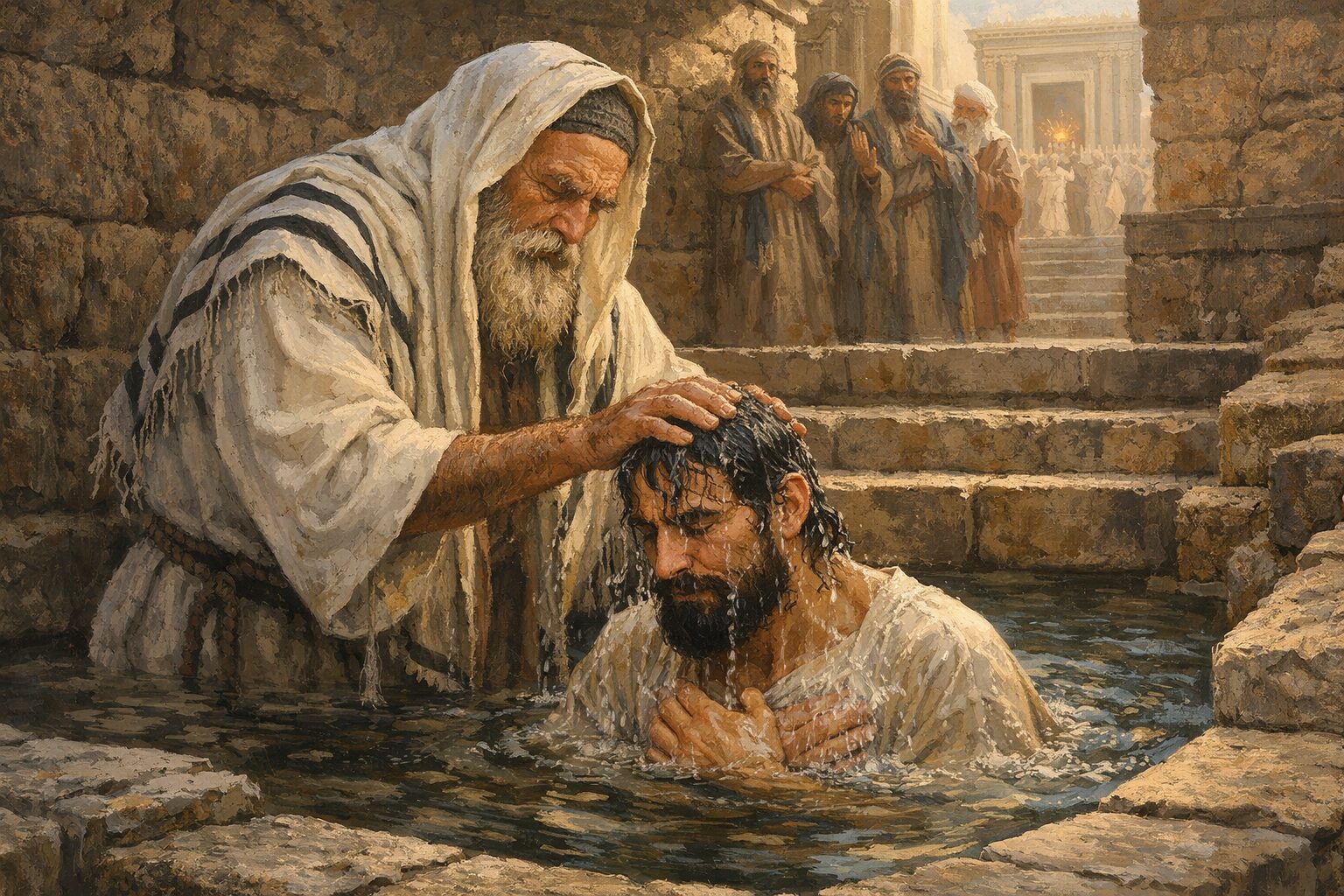
Immersion: Entering the Life of a Disciple
For many believers, baptism is treated as a symbolic milestone—important, but optional, and often disconnected from daily obedience. Yet when Scripture is read in its original context, immersion is revealed as something far more weighty. It is not merely a testimony of faith but an embodied commitment to discipleship, marking a decisive transition into a life shaped by obedience to God.
Immersion did not begin with Christianity. The Hebrew Scriptures already associate washing with transformation and readiness to approach God. Priests washed before service (Exodus 30:17–21), ritual impurity required immersion in water (Leviticus 15; Numbers 19), and the prophets envisioned cleansing water as part of Israel’s restoration (Ezekiel 36:25; Zechariah 13:1). By the Second Temple period, ritual immersion (mikveh) was a widespread and established practice in Jewish life, symbolizing movement from one state of life to another.¹
This background explains why John’s immersion ministry was immediately understood by the people. John did not invent immersion; he intensified its meaning. He called Israel to repentance and immersed those who confessed their sins, preparing them for the coming kingdom (Matthew 3:1–6; Mark 1:4). His message echoed the prophets: return to the LORD, turn from injustice, and bear fruit worthy of repentance (Isaiah 1:16–17; Malachi 3:1–3; Luke 3:8).
Yeshua’s own immersion confirms the significance of the act. Though sinless, He insisted on being immersed “to fulfill all righteousness” (Matthew 3:15). His immersion marked the beginning of His public mission, accompanied by the descent of the Spirit and the Father’s declaration of sonship (Matthew 3:16–17; Isaiah 42:1). Immersion here is not about sin removal but about vocation, obedience, and identification with God’s redemptive purposes for Israel.
This corrects a common misunderstanding: immersion is not a ritual that mechanically removes sin. Scripture consistently teaches that forgiveness comes from God’s mercy, not water. David cried, “Create in me a clean heart, O God” (Psalm 51:10), and Peter clarifies that immersion is “not the removal of dirt from the body, but an appeal to God for a good conscience” (1 Peter 3:21). Immersion responds to repentance; it does not replace it (Acts 2:38; Isaiah 55:6–7).
In the teachings of Yeshua, immersion is directly tied to discipleship. A disciple (talmid) was not merely a student of ideas but an apprentice who ordered his life after the teacher (Luke 6:40). When Yeshua commissioned His disciples, He commanded them to make disciples of the nations, immersing them and teaching them to obey everything He commanded (Matthew 28:19–20). Immersion marked entrance into His community and His way of life.
The book of Acts reflects this pattern consistently. Those who believed were immersed immediately (Acts 2:41; 8:12–13; 8:36–38; 10:47–48; 16:30–34). Faith, repentance, and immersion function as a unified response to the gospel, not as separate stages spaced far apart. Paul later explains that immersion unites believers with Messiah’s death and resurrection, calling them to “walk in newness of life” (Romans 6:3–6; Colossians 2:12).
For Gentile believers, immersion carries additional meaning. In Jewish thought, Gentiles who turned to the God of Israel underwent immersion as part of their transition into covenantal allegiance.² The apostles understood Gentile inclusion not as replacement of Israel, but as participation in Israel’s story through Messiah (Ephesians 2:12–19; Romans 11:17–18). Immersion marks this turning of allegiance—from former gods to the living God of Israel (1 Thessalonians 1:9).
Another misunderstanding is that immersion is a private act. Biblically, it is communal. Paul writes, “In one Spirit we were all immersed into one body—Jews or Greeks” (1 Corinthians 12:13). Immersion publicly binds the believer to the community of disciples and to a life shaped by obedience, holiness, and perseverance (Acts 2:42; Hebrews 10:22–25).
Immersion still matters today because discipleship still matters. Yeshua warned that calling Him “Lord” without obedience is self-deception (Luke 6:46). Immersion is one of the first acts of obedience He calls His followers to take. It does not earn salvation, but it declares loyalty. It does not complete faith, but it begins a life of faithful obedience (James 2:17; Philippians 2:12).
Like Israel passing through the sea (Exodus 14; 1 Corinthians 10:1–2), immersion marks a crossing—from the old life into a new one. The waters do not end the journey; they begin it. Immersion is the disciple’s embodied confession: I am no longer my own. I belong to the God of Israel, and I will walk in the way of His Messiah.
- Jonathan Klawans, Purity, Sacrifice, and the Temple: Symbolism and Supersessionism in the Study of Ancient Judaism (Oxford: Oxford University Press, 2006), 45–78; Eyal Regev, “Ritual Baths in Second Temple Jerusalem,” Journal for the Study of Judaism 40 (2009): 194–213.
- Shaye J. D. Cohen, “Crossing the Boundary and Becoming a Jew,” Harvard Theological Review 82 (1989): 13–33; Lawrence H. Schiffman, From Text to Tradition: A History of Second Temple and Rabbinic Judaism (Hoboken, NJ: Ktav, 1991), 304–310
Leave a Reply
You must be logged in to post a comment.